Choosing Commercial LED Lighting Installers
A lighting upgrade looks straightforward until the real questions start. Will the fittings suit the way the space is used? Can the install be phased without disrupting staff, customers or tenants? Will the savings on paper still stack up once emergency lighting, controls and access equipment are factored in? That is why experienced commercial LED lighting installers matter. The right installer does far more than swap old lamps for new ones.
For commercial sites, lighting affects energy bills, maintenance schedules, compliance, presentation and day-to-day usability. In a warehouse, poor light levels can slow operations and create safety issues. In a shop or hospitality venue, the wrong colour temperature can flatten displays and change the feel of the space. In offices, glare and uneven distribution can lead to complaints long before anyone mentions efficiency. Installation quality sits at the centre of all of it.
What commercial LED lighting installers should actually deliver
A competent installer should begin with the site, not the catalogue. That means looking at ceiling heights, existing wiring, switching layouts, access restrictions, operating hours and the purpose of each area. A retail floor, stock room, staff corridor and car park rarely need the same approach, even if they sit in the same building.
This is also where supply and fit together make a practical difference. When the same provider handles product selection and installation planning, there is less room for mismatch between specification and reality on site. It reduces delays, cuts down on substitutions and gives buyers a clearer route from quotation to completed fitting.
Commercial buyers should expect advice on more than simple one-for-one replacements. In many cases, upgrading to LED is a chance to improve output, reduce shadowing, add controls or replace ageing fittings that are expensive to maintain. That can involve high bays in industrial units, panel lights in offices, flood lights outside service yards, emergency fittings in shared routes or specialist products for hazardous and agricultural environments.
Why experience matters in commercial LED lighting installation
There is a clear difference between fitting LED products and managing a commercial lighting project properly. An experienced team understands that installation is often only one part of the job. Access may need to be arranged around trading hours. Tenants or staff may need notice. Certain areas may need to stay live while others are upgraded. In some buildings, old circuits or legacy fittings create complications that are not obvious at quotation stage.
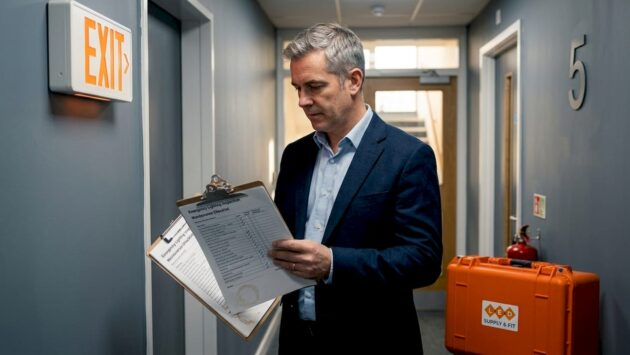
That experience is especially important in sites where compliance and operating conditions cannot be treated casually. Emergency lighting, exterior lighting, ATEX areas and specialist task lighting all require careful product choice and correct fitting. Cost savings matter, but they should never come at the expense of suitability or safe performance.
A good installer will also be honest about trade-offs. The cheapest fitting is not always the most economical once lifespan, warranty, lumen output and maintenance access are considered. Equally, a premium specification is not always necessary in lower-use areas. The best commercial advice is commercially grounded. It aims for the right result, not the highest spec on every line.
Commercial LED lighting installers for different sectors
Different sectors buy lighting for different reasons, and installers should reflect that in their recommendations. Offices often focus on reducing glare, lowering energy use and creating a cleaner, more modern environment. Replacing fluorescent panels with LED panels can improve consistency and cut maintenance, especially in larger estates.
Retail and hospitality projects usually place more emphasis on presentation. Light has to do a job visually as well as practically. In these settings, beam angle, colour temperature and fitting design matter more because they directly affect customer experience. A poor specification can make a refurbished space feel tired before the paint is dry.
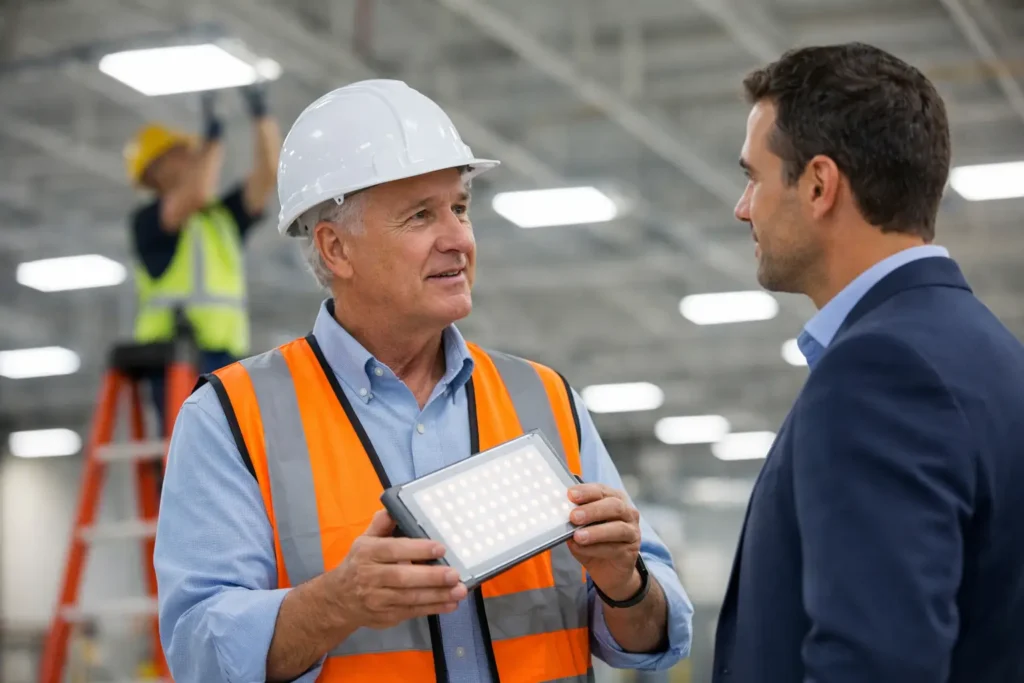
Warehouses, workshops and industrial premises are more likely to focus on light levels, reliability and energy reduction across large open areas. Here, high bay lighting, occupancy controls and durable fittings can make a significant difference to both running costs and operational visibility. For external areas such as yards, car parks and perimeters, well-specified flood lighting and street-style fittings improve safety and security while reducing power consumption.
Specialist sectors bring their own demands. Agricultural settings may require hard-wearing fittings that cope with dust, moisture and temperature changes. Hazardous environments need products designed for those conditions, not general fittings adapted as an afterthought. This is where a broad product range backed by technical guidance gives buyers a stronger position from the start.
How to assess commercial LED lighting installers
If you are comparing providers, start with the basics of capability. Can they supply the right product range for your site, or will they try to force a limited stockholding onto the job? Can they advise on indoor, outdoor, emergency and specialist applications if your premises require more than one category? Can they support phased projects, bulk orders and repeat requirements across multiple locations?
Then look at the operational side. Delivery times matter when projects are under pressure, especially for trade customers and contractors working to programme. Direct access to product guidance also matters. Commercial projects tend to move faster when buyers can get a straight answer on performance, compatibility and lead time without being passed from one department to another.
It is also worth asking how the installer approaches savings. Serious providers should be able to explain where the reductions come from, whether through lower wattage, reduced maintenance, better controls or longer product lifespan. Claims of dramatic savings can be accurate, but they depend on what is being replaced and how the site is used. A building running old fluorescent or discharge fittings for long hours will usually see stronger returns than a lightly used space with relatively modern lighting already in place.
What a well-run installation project looks like
A proper commercial LED upgrade is usually more methodical than people expect. First comes the review of the site and the lighting requirement. Then the product selection is narrowed to what suits the environment, usage and budget. After that, installation planning should deal with access, scheduling and any disruption risks.
On larger projects, a phased approach is often the sensible option. It allows critical areas to remain operational while upgrades happen in sections. For businesses that cannot afford downtime, that matters as much as the product itself. The project should finish with a clear, usable result – lighting that performs properly, reduces operating costs and does not create a fresh maintenance problem six months later.
That is one reason many buyers prefer a supply-and-fit model. Instead of sourcing products from one place and relying on another party to make them work on site, they get a joined-up service. For contractors and facilities teams, that can save time at every stage, from specification through to completion.
The cost question and the long view
Price will always be part of the decision, and rightly so. Commercial buyers have budgets, targets and procurement pressures. But the useful comparison is not just install cost versus install cost. It is total value over time.
A better LED fitting can last far longer, reduce maintenance call-outs and deliver stronger output with lower wattage. Across shops, offices, bars, restaurants, gyms and warehouses, those savings add up quickly when lighting runs for long periods. Bulk purchasing and trade support can improve the numbers further, particularly for multi-site businesses or contractors managing repeat specifications.
There is also the carbon reduction angle, which is no longer a side issue for many organisations. Lower energy consumption helps with cost control, but it also supports wider sustainability targets. For businesses under pressure to show practical improvements, lighting remains one of the more accessible upgrades because the benefits are visible and measurable.
A dependable provider should make that process easier, not more complicated. That means practical guidance, products that suit the job, fitting that is planned properly and service that recognises the pace of commercial work. LED Supply & Fit is built around that model, combining a broad product range with installation support that reflects real site conditions rather than textbook assumptions.
If you are reviewing your current lighting, the strongest next step is not simply asking what fitting is cheapest. It is asking what will work best for the building, the people using it and the budget you need to protect over the long term.