Master restaurant lighting design for perfect ambiance
You walk into your restaurant at peak service and notice tables near the windows are bathed in warm light while the back corner feels dim and uninviting. Poor lighting wastes energy, spoils ambiance, and drives customers away before they even glance at your menu. This guide breaks down the restaurant lighting design process with practical UK-focused insights, helping you create spaces that enhance both atmosphere and operational functionality through strategic LED lighting solutions.
Key Takeaways
| Point | Details |
|---|---|
| Structured design process | A clear, staged approach guides lighting decisions from brand identity to functional areas. |
| Layered lighting strategy | A layered approach combines ambient, task and accent light to shape atmosphere while supporting practicality. |
| High CRI colour temperature | Choosing high CRI lighting and a suitable colour temperature improves dish appeal while reducing energy consumption. |
| Testing and maintenance | Ongoing checks ensure lasting performance and timely problem detection. |
Understanding your restaurant’s lighting needs
Before selecting a single fixture, you must define what your lighting needs to accomplish. The restaurant lighting design process typically follows a structured workflow starting from defining brand identity and atmosphere. Your brand personality guides every lighting decision.
A casual family restaurant requires different lighting than an intimate fine dining establishment. Bright, even illumination suits quick service venues where turnover matters. Softer, layered lighting creates the lingering atmosphere fine dining demands. Your lighting must reflect your positioning.
Map every functional area in your space. Dining zones need comfortable ambient light for conversation and food appreciation. Bar areas require task lighting for drink preparation plus accent lighting to showcase bottles and create visual interest. Kitchen spaces demand bright, shadow-free illumination for food safety and efficiency. Entrances, restrooms, and waiting areas each have distinct requirements.
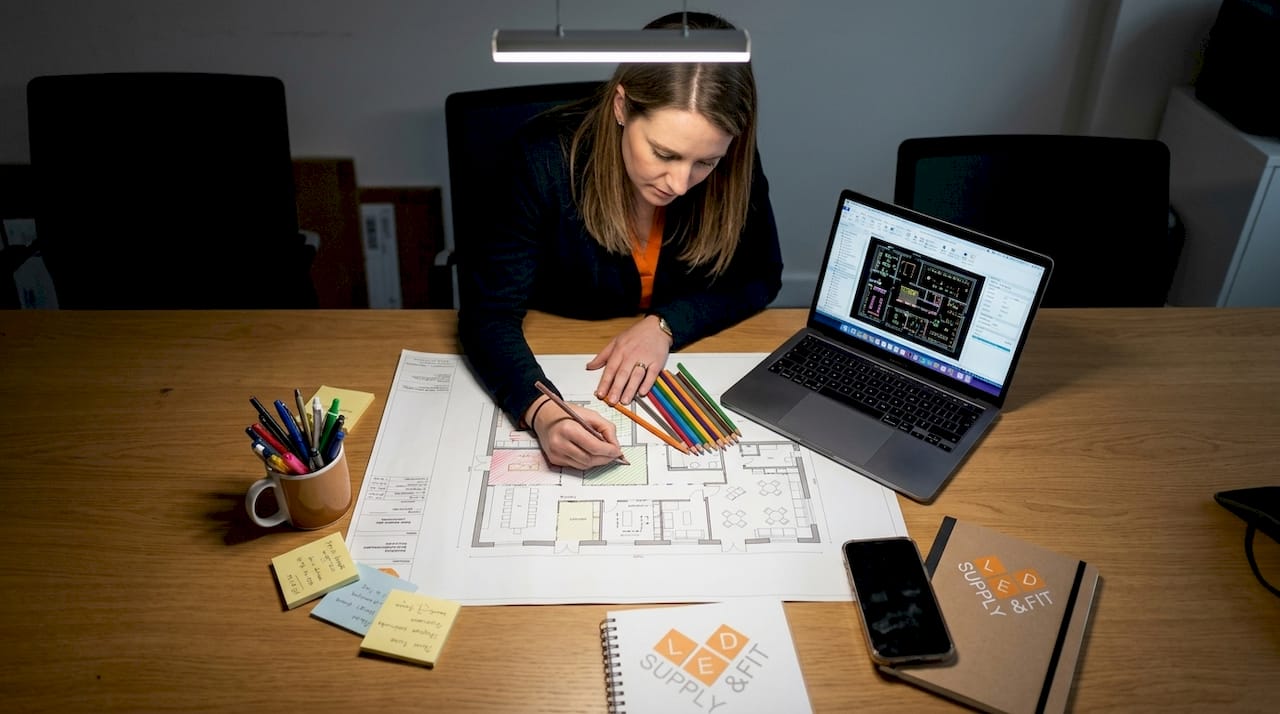
Establish specific lighting goals for each mapped area. Dining tables need 150-200 lux for comfortable reading of menus whilst maintaining intimacy. Food preparation areas require 500 lux minimum for safety compliance. Consider UK building regulations and energy efficiency targets for commercial spaces when planning.
Pro Tip: Involve your front-of-house staff and regular customers in lighting preference discussions before finalising your design. They experience the space daily and can identify problem areas you might overlook.
Your preparation stage should answer these questions:
- What atmosphere do we want customers to feel upon entering?
- Which areas need bright task lighting versus softer ambient lighting?
- How will lighting support our brand identity and menu presentation?
- What energy efficiency targets must we meet for UK compliance?
- How much flexibility do we need for different service periods?
Selecting lighting layers and technical specifications
Effective restaurant lighting relies on layering multiple light types to create depth and functionality. Common pitfalls include overlooking CRI, lack of dimming, and poor layering resulting in dull or harsh spaces. Understanding each layer prevents these mistakes.
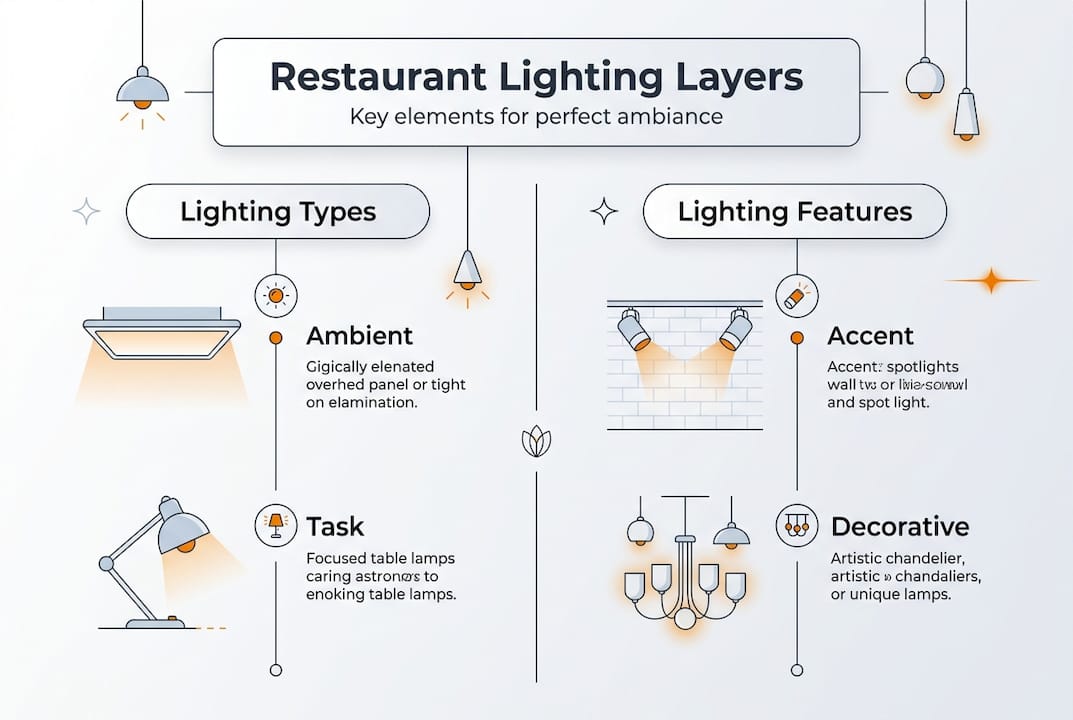
Ambient lighting provides your base illumination. This general lighting creates comfortable brightness throughout the space without harsh shadows. Recessed downlights, pendant fixtures, or track lighting typically deliver ambient layers. Aim for uniform distribution avoiding dark corners that feel unwelcoming.
Task lighting serves functional areas where precision work occurs. Kitchens need bright, shadow-free illumination for food preparation and plating. Bar areas require focused lighting for mixing drinks and reading labels. Service stations benefit from targeted task lighting for order processing.
Accent lighting adds drama and highlights specific features. Uplighting on textured walls creates visual interest. Spotlights on artwork or architectural details draw the eye. Grazing light across stone or brick surfaces adds depth and texture. Strategic accent lighting transforms flat spaces into memorable environments.
Decorative lighting expresses your brand personality. Statement chandeliers, vintage Edison bulbs, or custom pendants become focal points. These fixtures provide both illumination and aesthetic impact, reinforcing your restaurant’s unique character.
| Lighting layer | Primary purpose | Typical fixtures | Common applications |
|---|---|---|---|
| Ambient | General illumination | Recessed downlights, pendants | Dining areas, corridors |
| Task | Functional precision | Under-cabinet strips, focused spots | Kitchens, bars, service areas |
| Accent | Highlighting features | Adjustable spots, wall washers | Artwork, architectural details |
| Decorative | Aesthetic expression | Chandeliers, feature pendants | Dining rooms, entrances |
Technical specifications determine lighting quality and operational efficiency. Colour temperature measured in Kelvin dramatically affects atmosphere. 2700K provides warm, inviting light ideal for dining areas. This warmth makes skin tones flattering and creates cosy ambiance. Avoid cool temperatures above 4000K in dining spaces as they feel clinical and uninviting.
Colour Rendering Index (CRI) measures how accurately light reveals true colours. High CRI LEDs above 90 make food look vibrant and appetising. Low CRI fixtures produce dull, unnatural colours that diminish food appeal. Never compromise on CRI for dining and food presentation areas.
Dimmability provides essential flexibility. Your lighting needs differ between lunch service, dinner service, and private events. Dimmable fixtures allow you to adjust brightness and atmosphere throughout operating hours. Specify compatible dimming systems during fixture selection to avoid compatibility issues later.
Pro Tip: Order sample LED fixtures and test them with your actual dishes and table settings before committing to full installation. Colours and ambiance look different under real conditions than in catalogues.
Consider these LED lighting tips for businesses when specifying fixtures. LED technology offers superior energy efficient lighting compared to traditional options whilst providing better colour quality and dimming performance.
Planning layout, simulation and installation
Precise planning prevents costly mistakes and ensures your lighting design achieves intended results. Photometric simulations (e.g., with DIALux) support precise layout for required lux levels and uniformity. This software models light distribution before you purchase a single fixture.
Photometric software allows you to input room dimensions, surface reflectances, and fixture specifications. The programme calculates illuminance levels, uniformity ratios, and glare indices. You can visualise how light will appear and make adjustments before installation begins. DIALux is industry standard and offers free versions suitable for restaurant projects.
Follow this systematic approach for flawless implementation:
- Create detailed floor plans showing all furniture, equipment, and architectural features that affect light distribution
- Input your chosen fixtures into photometric software with accurate technical specifications from manufacturer data sheets
- Run simulations to verify lux levels meet requirements for each functional area without creating harsh contrasts or dark spots
- Adjust fixture placement, quantities, and beam angles based on simulation results until achieving optimal distribution
- Generate lighting schedules documenting fixture types, locations, circuit assignments, and control zones for electrician reference
- Engage certified electricians experienced with commercial LED systems to execute installation according to UK wiring regulations
- Commission the system by testing all circuits, dimming functions, and preset scenes to ensure proper operation
- Train staff on lighting controls, scene selection, and basic troubleshooting before handover
Work exclusively with electricians holding proper commercial qualifications. LED systems require different installation techniques than traditional lighting. Dimming systems need compatible drivers and controls. Poor installation causes flickering, premature failure, and safety hazards.
Installation phases include mounting fixtures, running control wiring, configuring dimming systems, and programming scene presets. Scene presets allow staff to recall lighting configurations instantly. Programme separate scenes for breakfast service, lunch, dinner, and special events. This simplifies daily operations whilst ensuring consistent ambiance.
| Parameter | Typical UK restaurant value | Notes |
|---|---|---|
| Colour temperature (dining) | 2700K | Warm, inviting atmosphere |
| Colour temperature (kitchen) | 4000K | Bright, neutral for food safety |
| CRI | >90 | Essential for food presentation |
| Lux level (dining) | 150-200 | Comfortable for reading menus |
| Lux level (kitchen) | 500+ | Required for safety compliance |
| Power consumption | 8-12 W/m² | LED efficiency target |
Commissioning involves systematic testing of every lighting circuit and control function. Verify dimming operates smoothly without flickering or dead spots. Check that preset scenes recall correctly and transitions between scenes appear seamless. Correct any anomalies before final handover.
Maintain comprehensive documentation including fixture schedules, circuit diagrams, control programming, and maintenance schedules. This information proves invaluable when you need to upgrade commercial lighting or troubleshoot issues years later. Proper planning pays dividends throughout your lighting system’s lifespan, as demonstrated by projects like Kings Quality Foods LED savings where systematic upgrades delivered substantial energy reductions.
Troubleshooting common pitfalls and ensuring long-term success
Even well-planned lighting systems face challenges without proper attention to common pitfalls and ongoing maintenance. Neglecting CRI and dimming flexibility are frequent pitfalls causing poor food presentation and inflexible ambience. Understanding these issues helps you avoid expensive corrections.
Low CRI LEDs represent the most damaging mistake in restaurant lighting. Food appears dull and unappetising under poor colour rendering. Customers perceive lower food quality even when your kitchen delivers excellence. Never compromise on CRI to save initial costs. The impact on customer experience far outweighs any savings.
Lacking dimming capability severely limits your operational flexibility. Fixed brightness cannot adapt to different service periods or customer preferences. Lunch service typically benefits from brighter lighting whilst dinner service demands softer ambiance. Without dimming, you cannot optimise atmosphere throughout operating hours.
Poor layering creates flat, uninspiring spaces. Relying solely on ambient lighting produces monotonous illumination lacking depth or visual interest. Harsh overhead lighting without accent layers feels institutional rather than inviting. Proper layering combining ambient, task, and accent sources creates the dimensional quality customers find appealing.
“Overlooking CRI leads to dull food; no dimming limits flexibility. These two factors alone account for most restaurant lighting failures and customer complaints about atmosphere.”
Implement these troubleshooting actions for typical lighting issues:
- Flickering lights indicate incompatible dimmers or failing LED drivers requiring replacement with proper components
- Uneven illumination suggests poor fixture placement or inadequate simulation during planning requiring repositioning or additional fixtures
- Colour shifts over time signal low quality LEDs needing replacement with higher specification products
- Glare complaints require beam angle adjustments, fixture repositioning, or adding diffusers to soften light output
- Insufficient brightness in task areas demands higher lumen output fixtures or additional supplementary lighting
Regular maintenance preserves lighting quality and extends system lifespan. Clean fixtures quarterly to prevent dust accumulation that reduces light output. Inspect connections and mounting hardware annually to identify loose components before they cause failures. Replace any failed LEDs promptly to maintain uniform appearance.
Plan periodic upgrades incorporating newer LED technologies as they become available. LED efficiency and colour quality continue improving. Upgrading to latest generation products every five to seven years maintains optimal performance whilst reducing energy consumption further.
Track energy usage through your electricity bills to verify expected savings materialise. Monitor customer feedback and online reviews for lighting-related comments. Positive remarks about ambiance validate your design whilst complaints signal areas needing adjustment.
Pro Tip: Create multiple preset scenes programmed for different operating scenarios including standard lunch, romantic dinner, private event, and cleaning mode. Staff can instantly adapt lighting to match service requirements without manual adjustments.
Your lighting system represents a significant investment deserving ongoing attention. Following best LED lighting tips UK businesses use ensures you maximise return on that investment through reduced energy costs, enhanced customer experience, and minimised maintenance requirements. Systematic attention to quality, maintenance, and continuous improvement keeps your restaurant lighting performing optimally for years.
Enhance your restaurant lighting with LED Supply & Fit
Transforming your restaurant lighting from problematic to perfect requires expertise and quality products. LED Supply & Fit specialises in best commercial LED lighting solutions tailored specifically for UK restaurants, bars, and hospitality venues.
Our team provides comprehensive consultation services helping you navigate the entire design process from initial needs assessment through installation and commissioning. We supply high CRI LED fixtures with proper dimming compatibility ensuring your lighting enhances food presentation and atmosphere. Our commercial-grade products deliver the reliability and performance restaurant environments demand.
Stay current with 2026 LED technology advances through our up-to-date product range. We understand the unique challenges restaurant lighting presents and offer practical LED lighting tips based on real-world commercial installations. Whether you’re planning a complete renovation or targeted upgrades, we provide the expertise and products needed for success.
Request a lighting quote today to discuss your specific requirements with our experienced team. We’ll help you create the perfect lighting environment that enhances your brand whilst delivering substantial energy savings.
Frequently asked questions about restaurant lighting design process
How does colour rendering index (CRI) affect restaurant lighting?
CRI measures how accurately light reveals true colours, which is absolutely critical for food appeal and presentation. High CRI LEDs above 90 make dishes look vibrant, fresh, and natural, encouraging orders and positive customer perceptions. Low CRI lighting produces dull, unappetising food appearance that damages your reputation regardless of actual food quality.
What is the ideal colour temperature for restaurant lighting?
2700K is the most common choice for warm, inviting atmosphere in dining areas, creating flattering skin tones and cosy ambiance. This warm white light makes customers feel comfortable and encourages longer stays. Avoid overly cool light above 4000K in dining spaces as it feels harsh, clinical, and uninviting, though cooler temperatures work well in kitchen prep areas.
How can I maintain my restaurant’s lighting for best long-term results?
Regular fixture cleaning every three months prevents dust accumulation that reduces light output and colour quality. Schedule annual inspections of connections, mounting hardware, and dimming systems to identify issues before they cause failures. Monitor customer feedback and energy usage to verify performance remains optimal, adjusting settings as needed based on real-world results.
Why is layering important in restaurant lighting design?
Layering combines ambient, task, and accent lighting to create balanced spaces with depth and visual interest. This approach prevents the harsh, flat lighting that results from relying on a single light source. Proper layering delivers the flexibility needed for different service periods whilst highlighting architectural features and creating the dimensional quality that makes spaces feel sophisticated and inviting.