
Bulk LED procurement process: save costs and upgrade
Cutting energy bills, meeting sustainability targets, and keeping tenants satisfied are three goals that rarely feel simple to achieve at once. When you add compliance requirements, budget constraints, and the sheer scale of a commercial lighting upgrade, the pressure mounts quickly. Getting your bulk LED procurement process right from the outset is the single most effective way to avoid wasted spending, regulatory headaches, and disruptive retrofits down the line. This guide walks you through every stage, from initial site assessment to post-installation monitoring, so you can make confident, cost-effective decisions.
Key Takeaways
| Point | Details |
|---|---|
| Site audit is crucial | A thorough site survey and lighting audit ensures the right LED quantity and compliance. |
| Choose procurement wisely | Direct bulk buys, frameworks, or tenders each offer pros and cons for your property’s needs. |
| Plan for total cost | Consider installation, long-term energy savings, and maintenance, not just upfront price. |
| Sample and stage installs | Always sample test products and use phased installation to minimise risk and disruption. |
Why bulk LED procurement matters for UK businesses
Bulk LED procurement is not simply about ordering more units at once. It is a strategic decision that affects your energy costs, compliance standing, and long-term maintenance burden for years ahead.

The financial case is compelling. Tiered pricing structures can deliver savings of 10 to 35% compared with ad-hoc purchasing, which adds up significantly across a large estate or multi-site portfolio. Beyond the unit price, bulk orders allow you to standardise fittings, simplify future replacements, and reduce the administrative overhead of managing multiple suppliers.
From a regulatory standpoint, the future of LED lighting in the UK is closely tied to tightening energy efficiency legislation. Businesses that plan procurement strategically are far better positioned to meet those obligations without emergency spending. The cost saving tips for LED lighting available to commercial operators in 2026 are substantial, but only if procurement is handled correctly from the start.
Key benefits of a well-managed bulk procurement process include:
- Significant unit cost reductions through volume discounts and tiered pricing
- Consistent light quality across all areas of your premises
- Simplified maintenance with uniform fittings and a single supplier relationship
- Stronger compliance footing under UK energy efficiency and building regulations
- Reduced carbon footprint, supporting ESG reporting and sustainability commitments
Ignoring total cost of ownership or compliance risks can result in fines, higher long-term costs, and the need for premature replacements. The reasons to upgrade to LED are clear, but the process matters just as much as the decision itself.
Step 1: Conducting a thorough site survey and lighting audit
Every sound procurement process starts with proper groundwork. Skipping this stage is the single most common reason commercial lighting projects run over budget or fail to meet compliance standards.
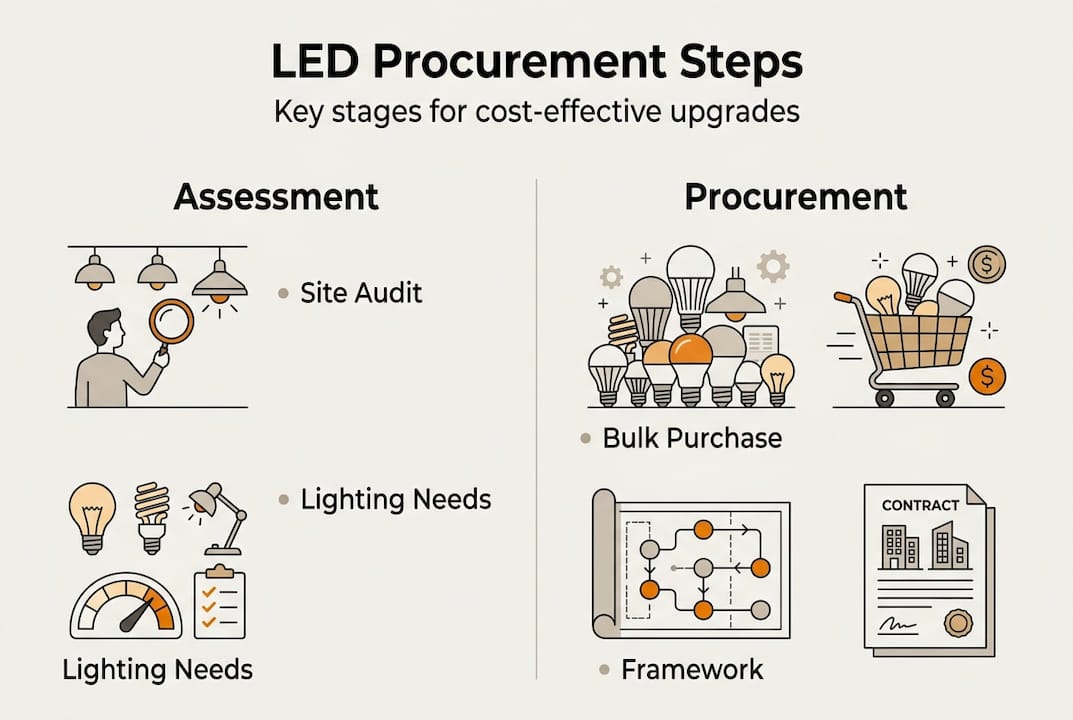
A site survey and lighting audit forms the foundation of your entire specification. It tells you exactly what you need, where you need it, and at what performance level. Here is how to approach it systematically:
- Map every space by room type, dimensions, ceiling height, and primary usage (office, warehouse, retail floor, corridor, and so on).
- Identify special conditions such as damp environments, dusty atmospheres, or areas requiring ATEX-rated fittings for hazardous locations.
- Measure existing lux levels using a calibrated lux meter, then compare against BS EN 12464-1 targets for each space type.
- Calculate fixture requirements using the formula: room area multiplied by target lux, divided by the fixture lumen output, then add a 20% safety margin to account for light loss over time.
- Document wiring and control infrastructure to identify any compatibility issues before ordering.
A practical example: a 200 square metre open-plan office with a target of 500 lux, using 4,000 lumen LED panels, would require approximately 30 fixtures before the safety margin, and around 36 once it is applied.
| Tool | Measurement taken | Data collected |
|---|---|---|
| Lux meter | Existing light levels | Compliance gaps |
| Tape measure or laser | Room dimensions | Fixture quantity estimate |
| Wiring diagram | Circuit capacity | Compatibility check |
| Ceiling height gauge | Mounting height | Beam angle selection |
| Site notes or app | Special conditions | IP rating requirements |
Pro Tip: If the property is leased, involve the landlord at this stage. Structural changes or alterations to electrical infrastructure may require written consent, and discovering this after ordering stock is an expensive delay.
The how to upgrade commercial lighting process becomes far smoother when your audit data is thorough. Use the energy efficient lighting guide to cross-reference lux targets and ensure your specification aligns with current standards. Reviewing LED lighting best tips at this stage can also help you avoid over-specifying, which wastes budget without improving outcomes.
Step 2: Selecting the right bulk procurement method
With your site needs clearly defined, the next decision is how to actually purchase. There are three main routes, and each suits different scenarios.
Direct bulk purchase means ordering directly from a supplier at agreed volume pricing. It is fast, flexible, and well-suited to straightforward projects where you have a clear specification and an established supplier relationship. The trade-off is that it requires you to manage quality assurance and compliance verification yourself.
Framework agreements are pre-negotiated contracts, often used by public sector bodies, housing associations, and large commercial estates. They offer compliant rapid procurement with pre-vetted suppliers, reducing administrative burden and legal risk. The downside is less flexibility on product selection and potentially longer setup times if you are joining a new framework.
Tender processes (also known as RFP or request for proposal) are appropriate for very large or complex projects. They invite competitive bids, which can drive down costs, but they require significant time and resource to manage.
| Procurement method | Best for | Speed | Cost control | Compliance assurance |
|---|---|---|---|---|
| Direct bulk purchase | SMEs, clear specs | Fast | High | Self-managed |
| Framework agreement | Public sector, large estates | Medium | Medium | Built-in |
| Tender / RFP | Major projects | Slow | Very high | Formal process |
Advantages and disadvantages at a glance:
- Direct purchase: Quick to execute, full product flexibility, but requires internal compliance checks
- Framework: Pre-vetted, legally safer, but less product choice and more rigid terms
- Tender: Maximum cost competition, but resource-intensive and slow for urgent projects
Non-compliant procurement, regardless of method, exposes your business to regulatory fines, insurance complications, and the cost of remedial works. Always verify that products carry the correct certifications before committing to a bulk order.
The LED lighting cost saving overview for 2026 makes clear that procurement method directly influences your return on investment. Choosing sustainable lighting for commercial properties also strengthens your ESG credentials, which is increasingly relevant for tenants and investors alike.
Step 3: Practical considerations and common pitfalls
Having chosen your procurement path, the next challenge is avoiding the mistakes that derail even well-planned projects.
Edge cases catch many property managers off guard. Leased properties may require landlord sign-off before any electrical work begins. Ageing wiring infrastructure may not support modern LED drivers without an upgrade. Harsh environments such as commercial kitchens, car parks, or industrial units require IP65-rated fittings as a minimum, and hazardous locations demand ATEX-certified products.
The most common technical pitfalls include:
- Skipping sample testing: Always request samples and install them in representative areas before committing to a full bulk order
- Ignoring electrical compatibility: Audit electrical compatibility before ordering, particularly for older premises with magnetic ballasts or non-standard wiring
- Overlooking smart controls: DALI dimming systems and motion sensors can add significant efficiency gains that a basic swap-out misses
- Underestimating disruption: Installing across an operational site without a phased plan causes unnecessary downtime and tenant complaints
- Focusing only on purchase price: Total cost of ownership (TCO) includes installation, maintenance, energy consumption, and disposal. A cheaper fitting that fails in three years costs far more than a quality product with a five-year warranty.
Pro Tip: Stage your installation in phases, starting with the highest-energy-use areas first. This generates early savings that can offset the cost of subsequent phases, making the project self-funding over time.
The benefits of energy saving lights are only fully realised when the installation is done correctly. Use the LED lighting cost-saving tips to build a realistic TCO model before finalising your specification.
Step 4: Verification, commissioning, and performance monitoring
With equipment on-site and ready, protecting your investment means verifying every element before signing off.
Follow these steps to commission your installation correctly:
- Check delivered products against the purchase order, verifying model numbers, wattages, IP ratings, and certifications.
- Commission the installation with a qualified electrician, ensuring all circuits are correctly loaded and controls are configured.
- Measure post-upgrade lux levels in every key area using a calibrated lux meter, and document results against BS EN 12464-1 targets.
- Test smart controls including DALI systems, motion sensors, and daylight harvesting functions to confirm they are operating as specified.
- Record all compliance documentation, including installation certificates, product data sheets, and warranty information.
Integrating smart controls and phased installs is not just good practice. Smart controls alone can add 20 to 50% energy savings on top of the baseline LED efficiency gain, making them a worthwhile addition to almost any commercial project.
Once commissioned, set a schedule for ongoing performance monitoring. Review energy consumption data quarterly, inspect fittings annually, and log any failures against warranty terms. The business benefits of LED installation compound over time when maintenance is proactive rather than reactive.
Accelerate your LED upgrade with professional support
Following this process gives you a strong foundation, but complex multi-site projects or tight compliance deadlines often benefit from expert involvement at every stage. Working with a specialist supplier and installer removes the risk of specification errors, procurement delays, and post-installation compliance gaps.

At LED Supply and Fit, we have delivered smarter LED lighting solutions for commercial clients across the UK, from independent retailers to large educational estates. The Wilson Veterinary Group case study demonstrates how a professional approach to specification and installation delivers measurable energy savings with minimal disruption. Similarly, the Stockton Riverside College results show the scale of savings achievable on larger estates when procurement and installation are managed end-to-end. If you are ready to start with a site survey, a lighting audit, or simply want to discuss your bulk order requirements, get in touch with our team today.
Frequently asked questions
How does bulk LED procurement cut costs for UK businesses?
Bulk procurement leverages tiered pricing structures to deliver typical savings of 10 to 35% compared with ad-hoc purchasing, while also reducing administrative and maintenance costs through supplier consolidation.
What is a site survey and why is it so important?
A site survey and audit assesses lighting needs, space usage, and compliance requirements to ensure the correct LED products are selected, preventing costly over or under-lighting and future remedial work.
What mistakes should I avoid in my LED procurement process?
The most damaging mistakes include skipping a site-specific audit, failing to test samples before bulk ordering, and ignoring total cost of ownership, which leads to higher long-term costs despite a lower initial purchase price.
Can I use frameworks for fast, compliant LED procurement?
Framework agreements provide rapid access to pre-vetted suppliers and built-in regulatory compliance, making them an efficient route for public sector bodies and large commercial estates with formal procurement obligations.