
Streamline your bulk lighting installation workflow
TL;DR:
- Proper planning, scoping, and scheduling are essential to avoid cost overruns and disruption.
- Sourcing high-quality, certified LED fittings with warranties maximizes value and future savings.
- Effective communication and post-installation evaluation ensure a successful, compliant, and energy-efficient upgrade.
Getting bulk LED lighting installed across a commercial property sounds straightforward until the reality hits: mismatched fittings, unplanned downtime, confused contractors, and a final bill that bears little resemblance to the original quote. For UK property managers and business owners, inefficient installation workflows are one of the most avoidable sources of cost and disruption. This guide walks you through a proven, step-by-step approach to planning, sourcing, scheduling, and executing bulk LED upgrades so your premises stay operational and your budget stays intact.
Key Takeaways
| Point | Details |
|---|---|
| Scoping is vital | Assess your needs and infrastructure before approaching suppliers to prevent wasted resources. |
| Bulk savings add up | Buying commercial LED lighting in bulk lowers costs and secures sourcing consistency. |
| Planning prevents disruption | A detailed installation schedule minimises business downtime and keeps teams informed. |
| Quality checks matter | Rigorous quality control during and after installation ensures long-term savings and compliance. |
| Expert help pays off | Leveraging professional installers ensures your workflow meets strict UK safety and energy standards. |
Assessing needs and scoping your lighting project
Before a single fitting is ordered, you need a clear picture of what you actually require. Skipping this stage is the single most common reason bulk installations run over budget or require costly rework. Thorough project scoping reduces installation errors and unexpected costs, so treat this phase as non-negotiable.
Start by defining your goals. Are you primarily chasing energy savings, improving compliance with current UK standards, or upgrading the quality of light for staff and customers? Each goal shapes different decisions. Then survey your existing infrastructure: note fitting types, ceiling heights, wiring configurations, and any areas with specialist requirements such as emergency lighting or damp-rated zones.
Review lighting design considerations early, and cross-reference your findings against CIBSE lighting recommendations for your building type. These benchmarks give you defensible targets for lux levels and energy performance.
Key scoping checklist:
- Total number of fittings by type and zone
- Current wattage versus target LED wattage
- Emergency and safety lighting requirements
- Zones needing specialist fittings (kitchens, cold stores, hazardous areas)
- Stakeholders to involve: facilities manager, health and safety lead, finance
| Scoping factor | Why it matters |
|---|---|
| Fitting count and type | Drives procurement volume and cost |
| Lux level targets | Ensures compliance and comfort |
| Wiring compatibility | Avoids costly rewiring surprises |
| Emergency lighting zones | Legal requirement in most commercial buildings |
Pro Tip: Walk the building at different times of day. Natural light variation affects how many fittings each zone actually needs, and you may find some areas are already over-lit.
Sourcing the right bulk lighting solution
Once your requirements are documented, sourcing becomes a much more focused task. You know exactly what you need, so the conversation with suppliers shifts from browsing to negotiating.
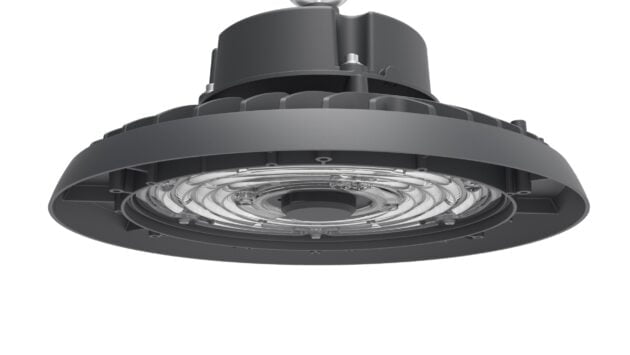
For commercial spaces, the most commonly specified products include LED panel lights, high-bay fittings for warehouses, recessed downlights for offices and retail, and batten fittings for corridors and service areas. Each has different lumen output, beam angle, and IP rating requirements, so match product specs to your scoping data.
Reliable procurement strategies drive bulk savings and ensure long-term value, but only when you choose suppliers carefully. Look for the following before placing any order:
- Minimum five-year product warranty
- UKCA or CE certification on all fittings
- Verified customer reviews from similar commercial projects
- Clear returns and replacement policy for faulty units
- Next-day or scheduled delivery to match your installation timeline
The Energy Saving Trust recommends prioritising products with strong efficiency ratings, which also positions your business well for future energy audits.
| Factor | Standard supplier | Quality bulk supplier |
|---|---|---|
| Warranty | 1 to 2 years | 5 years or more |
| Certification | Variable | UKCA/CE confirmed |
| Bulk discount | Rarely offered | Standard at volume |
| Delivery flexibility | Fixed lead times | Next-day options |
Explore bulk lighting savings available when ordering at scale, and review bulk LED options for offices if your project is predominantly open-plan workspace. Locking in a single supplier for your entire project also simplifies invoicing, warranty claims, and any mid-project substitutions.
Planning and scheduling the installation
With your order confirmed, the focus shifts entirely to logistics. Poor scheduling is where even well-sourced projects fall apart. Professional planning and scheduling minimises downtime and business risk, and it starts with a realistic timeline broken into phases.
A structured installation plan typically includes:
- Pre-installation site visit with your chosen contractor
- Agreement on working hours (out-of-hours, weekends, or phased by zone)
- Staff and building user communication, at least two weeks in advance
- Confirmation of health and safety arrangements, including isolation procedures
- Permits or landlord approvals where required
- Delivery scheduling to align with each installation phase
“The installations that run smoothest are always the ones where the site manager and the contractor have walked the building together before a single tool is unpacked.”
Review installation best practices to ensure your contractor is aligned with current standards, and factor in the broader energy saving benefits when presenting the project to senior stakeholders who need to approve access or budget.

Pro Tip: Build a 10% contingency into your timeline. Unforeseen issues such as outdated wiring or non-standard ceiling voids are common in older commercial buildings and can add days to a phase if not anticipated.
Executing installation and ensuring quality control
Execution is where preparation pays off. With a solid plan in place, your installation team should be able to work efficiently through each zone without surprises.
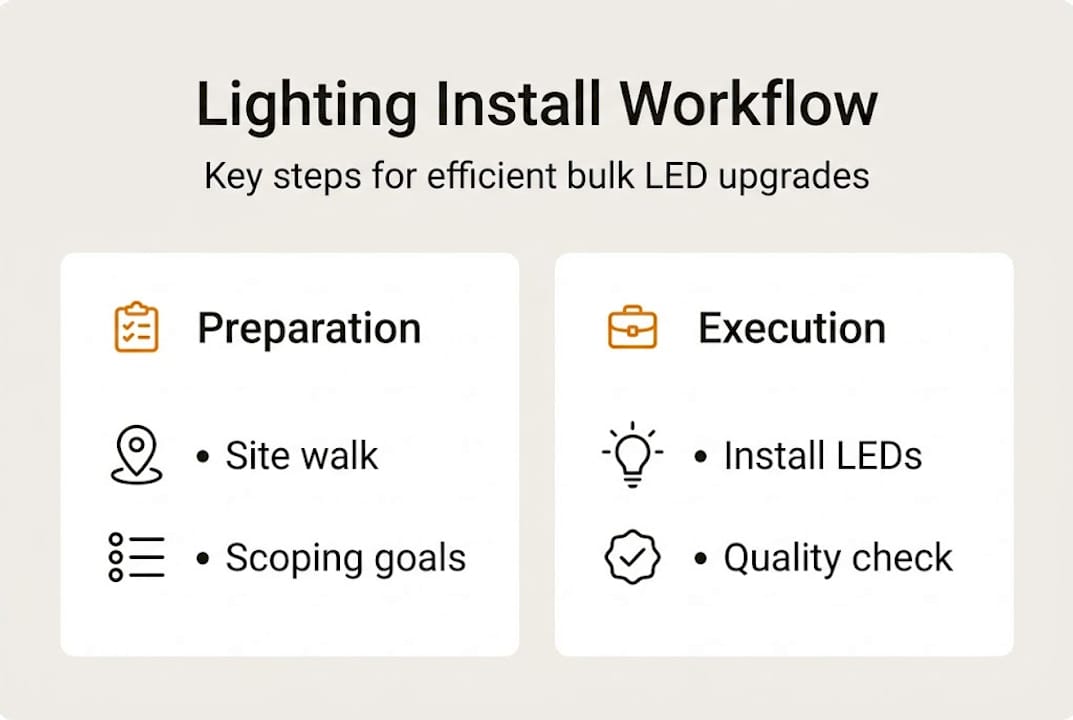
Step-by-step installation process:
- Isolate the relevant circuit and confirm isolation with a voltage tester
- Remove existing fittings and document any wiring anomalies
- Install new LED fittings according to manufacturer instructions
- Reconnect and test each circuit before moving to the next zone
- Check lux levels against your scoping targets using a light meter
- Complete a post-installation inspection with sign-off documentation
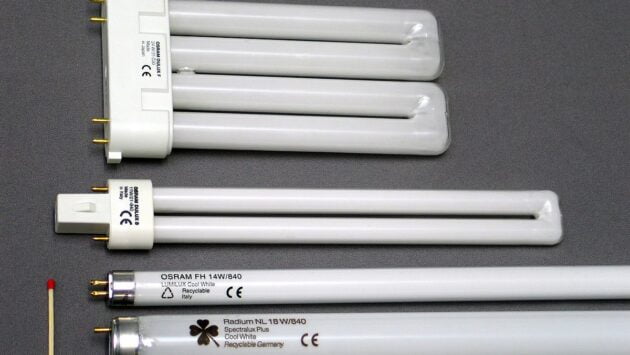
Quality control at every stage reduces rework and guarantees compliance, which matters when you consider that LED upgrades in UK commercial buildings can cut energy consumption by up to 70% compared to older fluorescent or halogen systems. That figure only holds if fittings are installed correctly and operating as specified.
For specialist environments such as kitchens, cold stores, or production areas, ensure fittings carry the correct IP rating and that your contractor is familiar with any sector-specific requirements. Always follow HSE electrical safety guidance throughout.
Post-installation quality checklist:
- All fittings illuminating at correct output
- Emergency lighting tested and logged
- No visible flickering or inconsistent colour temperature
- Documentation completed for warranty and compliance records
- Waste disposal of old fittings handled responsibly
Review your cost-saving strategies post-installation to track actual versus projected savings and build a case for future phases.
What most guides miss about bulk lighting installation
Most installation guides focus on the technical steps and stop there. What they rarely address is the human side of a bulk project, and that is where things quietly go wrong.
Cross-team communication between your facilities team, IT (for smart controls), and senior management is not a nice-to-have. It is what prevents a completed installation from sitting unused on manual override for six months because nobody trained the right people. Flexibility in your workflow matters too. Rigid phase plans that cannot absorb a supplier delay or a contractor illness create unnecessary pressure and poor decisions.
Perhaps most importantly, post-installation evaluation is often treated as optional. It is not. Tracking actual energy consumption against your pre-upgrade baseline is how you validate the investment and build the business case for future LED savings across other sites.
Get professional support for your bulk LED installation
If this workflow has clarified what a well-run bulk LED project looks like, the next step is finding a partner who can deliver it.

At LED Supply and Fit, we specialise in supplying and installing best commercial LED lighting for UK businesses of all sizes, from single-site shops to multi-location commercial estates. Our team handles everything from scoping to sign-off, and our bulk order savings mean you get competitive pricing without compromising on quality or compliance. Get in touch to discuss your project and receive a tailored quote.
Frequently asked questions
How can bulk lighting installations save my business money?
Bulk orders and LED upgrades lower operational costs by securing volume discounts on products and significantly reducing ongoing energy bills compared to older lighting technologies.
What compliance issues should I watch out for with commercial lighting installs?
Ensure all fittings meet UK energy efficiency standards, electrical safety regulations, and emergency lighting requirements. CIBSE guidance provides sector-specific benchmarks to help you stay on the right side of regulations.
How do I minimise disruption to my business during installation?
Effective scheduling through phased work, out-of-hours installation, and early staff communication keeps disruption to a minimum without extending the overall project timeline.
Is a professional installer necessary for bulk LED upgrades?
Yes. Professional installation ensures all work meets HSE electrical safety requirements, manufacturer warranty conditions, and UK compliance standards, which self-managed installations frequently miss.