What is a lighting demonstration? Guide for UK businesses
TL;DR:
- Lighting demonstrations provide verified data on energy savings, compliance, and visual performance.
- They reduce financial risk and disruption compared to full-scale upgrades.
- Demonstrations are essential for complex environments and support compliance and grant funding applications.
Many property managers assume that overhauling their commercial lighting means weeks of disruption, upfront capital risk, and a leap of faith on projected savings. A lighting demonstration removes all three barriers. By trialling LED solutions in a targeted area before full rollout, you get hard evidence on energy reduction, verified compliance with UK standards, and a clear picture of payback. This guide breaks down exactly what a lighting demonstration involves, how the process works step by step, and why it is quickly becoming the preferred approach for commercial property managers across the UK.
Key Takeaways
| Point | Details |
|---|---|
| Test-before-you-buy process | A lighting demonstration lets you see real results on your site before investing fully. |
| Up to 80% energy cuts | Lighting demos routinely deliver dramatic energy savings and rapid ROI for UK businesses. |
| Supports compliance | Demonstrations ensure your new lighting meets regulations such as EN 12464-1 and boosts EPC ratings. |
| Ideal for tricky installs | Trialling solutions in specialist environments or showrooms helps avoid costly mistakes. |
What is a lighting demonstration?
A lighting demonstration is a structured trial of LED products within a specific zone of your premises before you commit to a full installation. Think of it as a test drive, but for your building’s energy infrastructure. Rather than replacing every fitting at once, you install LED solutions in one area, gather real data, and make an informed decision about scaling up.
The mechanics are more rigorous than most people expect. The LED lighting selection process typically involves site surveys, lighting assessments, Dialux simulations to model lux levels and uniformity, temporary mock-ups or before-and-after comparisons in showrooms and warehouses, and post-installation verification against standards such as EN 12464-1 and BS EN 12464-1. These are the European and British standards that define the minimum illuminance levels required for different working environments.
What does a demonstration actually give you?
- Verified lux levels across the trial area, confirming whether lighting output meets legal requirements
- Energy meter readings showing real consumption versus your old fittings
- Visual inspection of colour rendering, glare control, and shadow quality
- User feedback from staff working in the trial zone
- A baseline for calculating full-site ROI before spending a penny on the rest
Crucially, a demonstration is not the same as a standard lighting upgrade. Understanding the full upgrade steps and how lighting design shapes outcomes helps you see why the trial phase is worth adding to your project timeline.
Pro Tip: Ask your supplier to run Dialux simulations before the physical trial begins. This lets you spot potential dark spots or over-lit zones on screen before any fittings go up.
The lighting demonstration process explained
Knowing what a demonstration involves is one thing. Seeing the exact workflow makes it far easier to plan around your operational calendar.
Here is how a typical commercial lighting demonstration unfolds:
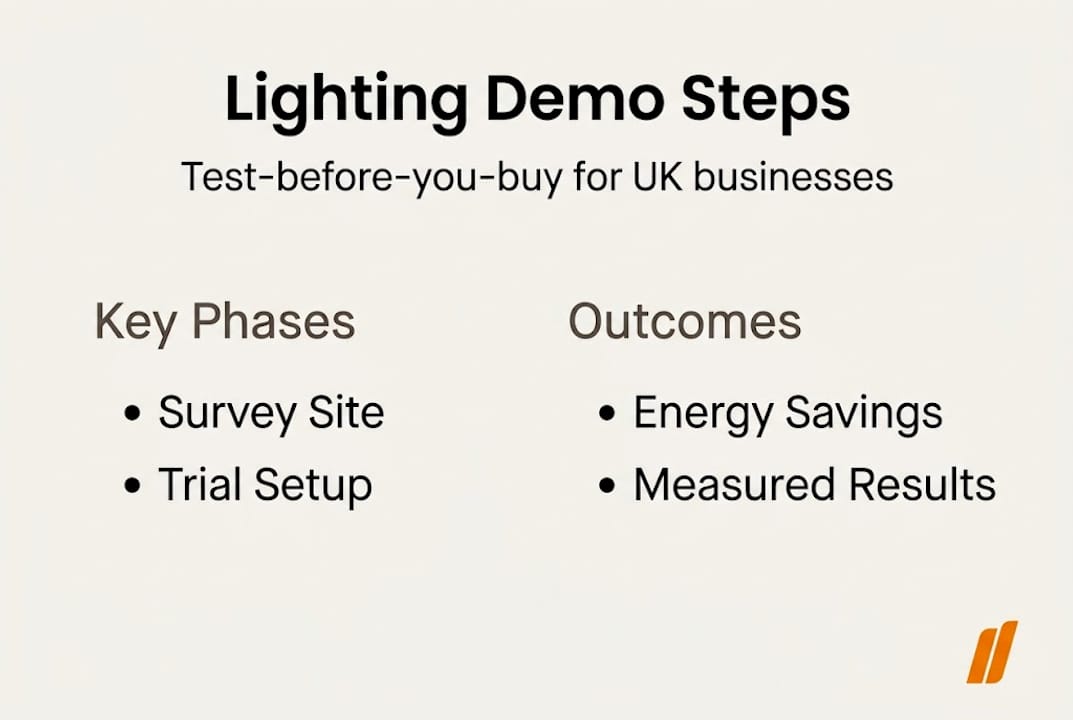
- Survey and assessment — A lighting specialist visits your premises, maps out zones, measures existing lux levels, and notes ceiling heights, reflective surfaces, and occupancy patterns.
- Dialux design — Using the survey data, a simulation models the proposed LED layout, confirming the cost and compliance impact before a single fitting is ordered.
- Demo or trial installation — LED fittings are installed in the chosen zone, often out of hours to minimise disruption.
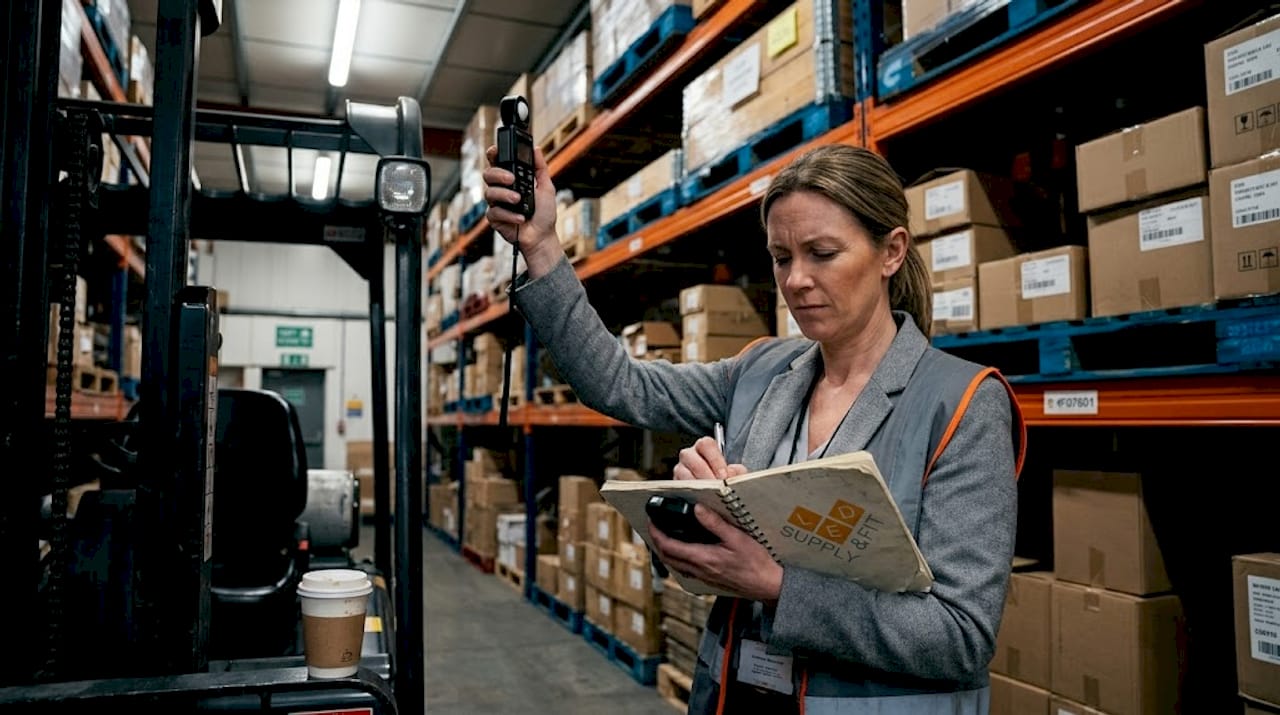
- Measurement — Lux levels are recorded across multiple points. For a warehouse task area, the target is typically 750 lux, and the demo confirms whether the layout achieves this.
- Full rollout decision — If the results satisfy your energy, visual, and compliance targets, the installation scales across the rest of the building.
| Factor | Demonstration approach | Direct upgrade ||
|—|—|—|
| Financial risk | Low — trial before commitment | Higher — full spend upfront |
| Disruption | Minimal — single zone | Site-wide |
| Compliance evidence | Verified pre-rollout | Confirmed post-install |
| Data quality | Real-world measurements | Projected estimates |
| Flexibility | Adjust design before scaling | Changes are costly after install |
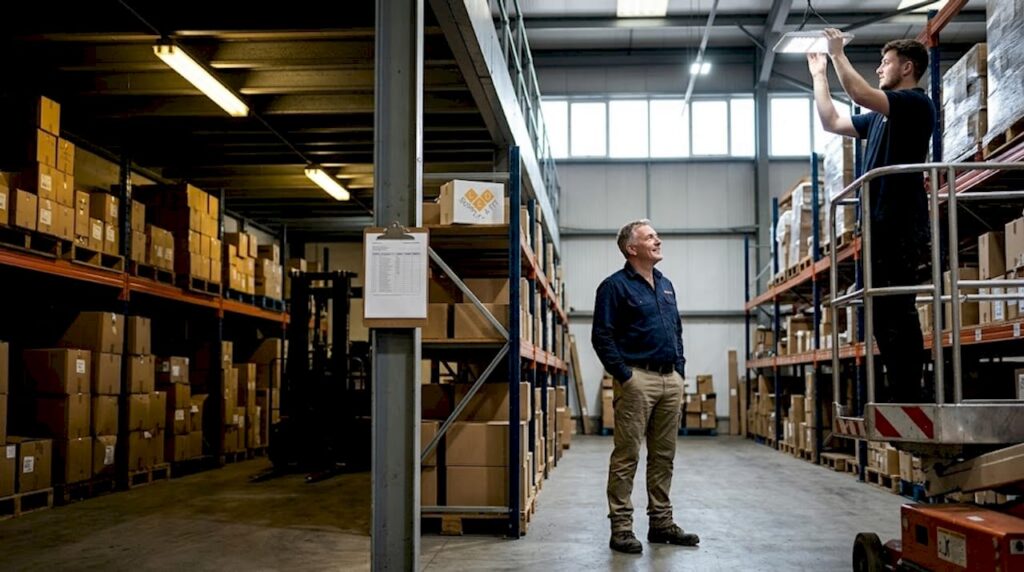
In a practical warehouse scenario, a property manager might trial high-bay LEDs along a single aisle. Within days, they have energy readings, lux data, and staff feedback confirming whether the chosen fitting is right for the full 20,000 sq ft floor.
Key benefits: energy savings, compliance, and ROI
The numbers behind lighting demonstrations are genuinely compelling. UK case data consistently shows 50 to 80% energy reductions after LED upgrades, with ROI typically achieved within one to five years. Mole Valley Farmers realised £1.1 million in savings and reduced CO2 by 3,420 tonnes over six years. A showroom retrofit delivered a 71% reduction in energy use, saving £12,000 per year. A warehouse installation cut consumption by 70%.
Those are not outliers. They reflect what happens when the right product is matched to the right space, which is precisely what a demonstration validates.
| Premises type | Energy reduction | Annual saving | Payback period |
|---|---|---|---|
| Warehouse | 70% | Significant | 2 to 3 years |
| Showroom | 71% | £12,000 | Under 3 years |
| Multi-site retail | 50 to 80% | Variable | 1 to 5 years |
Beyond the energy bill, demonstrations support compliance with MEES and EPC requirements, which are increasingly relevant for commercial landlords facing minimum energy efficiency obligations. Explore LED savings case studies and cost-saving strategies to see how other UK businesses have structured their projects.
Additional gains from a well-run demonstration include:
- Lower CO2 emissions supporting your sustainability reporting
- Improved workspace quality, reducing eye strain and boosting productivity
- Reduced maintenance costs from longer LED lamp life (often 50,000+ hours)
When is a lighting demonstration essential?
For straightforward office spaces, a demonstration is useful. For certain environments, it is non-negotiable.
High-ceiling industrial units need high-bay LEDs with integrated sensors, and the right positioning matters enormously for both safety and compliance. Cold storage facilities operating at below minus 20 degrees Celsius are ideal LED environments because LEDs actually perform better in cold conditions than fluorescent alternatives, but a trial confirms that the specific product handles your exact temperature range. Spaces with specific retail display requirements demand a CRI above 90 to render product colours accurately, and no amount of specification sheets can replace physically seeing how a fitting performs on your actual merchandise.
“Running a demonstration before mass rollout is the single most effective way to eliminate the risk of a costly mismatch between specification and real-world performance.” This is a principle consistently reinforced across commercial lighting projects throughout the UK.
Property managers pursuing grant funding or bulk upgrade programmes benefit enormously from demonstration data. Grant assessors and finance teams want verified evidence, not projections. The edge cases that justify demonstrations also include MEES and EPC compliance requirements, where verifiable lux levels and energy readings provide auditable proof of improvement.
Pro Tip: If you are considering a phased upgrade across multiple sites, start the demonstration in your highest-energy-use location. The savings data from that trial will build the strongest internal business case for rolling out across the rest of your portfolio.
A smarter approach: why lighting demonstrations win in real life
Here is a perspective that most lighting proposals will not share with you. Traditional quotes, however detailed, are essentially promises. They are built on assumptions about your space, your occupancy patterns, and your current consumption. Demonstrations replace assumptions with facts.
We have seen projects where a theoretically perfect specification produced disappointing results because ceiling reflectance or shift patterns were not accounted for. A demonstration catches this before it costs you. The upgrade process done right is not just about swapping fittings. It is about validating every variable. Free or subsidised demos reduce financial risk to near zero while providing real data you can take to your board, your insurer, or your EPC assessor. Quick wins in high-traffic corridors or car parks, then scaling via LaaS (Lighting as a Service) or zero-capex models, is a practical path that works in the real world.
Discover energy savings with trusted lighting demonstration partners
If the evidence above has made the case, the next step is finding a supplier who backs up the numbers with genuine on-site support.
At LED Supply & Fit, we guide commercial clients from initial survey through to full rollout, with verified results at every stage. Browse the best commercial LED options available for your premises type, and see how projects like the Wilson Veterinary Group case deliver tangible savings. Ready to see real numbers for your building? Arrange your site survey today with no obligation attached.
Frequently asked questions
How much does a lighting demonstration cost for a UK business?
Many reputable suppliers offer demonstrations at low or zero cost, particularly for larger sites or bulk upgrade projects where the commercial relationship justifies the investment.
How long does a typical lighting demonstration take?
Most demonstrations are completed within a few hours to a week, depending on the size of the trial zone and the complexity of the space being assessed.
Do lighting demonstrations affect business operations?
The vast majority of demonstrations use temporary setups or out-of-hours mock-ups, so day-to-day operations are rarely affected during the trial period.
What happens after a successful demonstration?
Once results meet your targets, your supplier schedules the full rollout and handles post-installation measurement to confirm compliance against agreed standards.
Can lighting demonstrations help with MEES and EPC compliance?
Yes. Demonstrations verify compliance against EN 12464-1 and BS EN 12464-1, providing auditable lux readings and energy data that directly support MEES and EPC improvement submissions.