
Office lighting checklist: efficiency tips and smart upgrades
TL;DR:
- UK office lighting must meet specific lux levels and compliance standards for different areas.
- LED lighting with smart controls offers significant energy savings, longer lifespan, and safety benefits.
- A systematic audit, proper specification, post-installation testing, and ongoing engagement optimize lighting performance.
Office lighting checklist: efficiency tips and smart upgrades
Choosing the right office lighting feels deceptively simple until you’re staring at a spreadsheet of lux levels, energy tariffs, and Building Regulations compliance requirements. Property managers and business owners across the UK face the same challenge: balancing staff comfort, legal obligations, and operational costs within a single lighting strategy. A structured office lighting checklist cuts through that complexity. This article gives you an actionable, standards-grounded framework to audit your current setup, evaluate LED options, and make confident decisions that deliver lasting savings.
Key Takeaways
| Point | Details |
|---|---|
| Meet UK lighting standards | Ensure office lighting achieves required lux levels, provides local controls, and supports user comfort and compliance. |
| Prioritise LEDs and smart controls | Switching to LED and adding smart controls maximises energy savings, increases ROI, and meets modern requirements. |
| Follow a structured checklist | Use a clear, repeatable process for auditing, installing, testing, and reviewing your office lighting system. |
| Avoid common lighting pitfalls | Check for incorrect brightness, lack of controls, and missed post-install reviews to keep lighting efficient and safe. |
Key standards and criteria for office lighting
Before you compare products or request quotes, you need a firm grasp of what UK standards actually require. The primary reference is HSE HSG38: Lighting at Work, which sets out minimum lux levels, preferences for natural light, and the role of localised controls in reducing occupant stress. Getting these benchmarks wrong means your upgrade may look impressive on paper but fail a compliance audit or create discomfort that undermines productivity.
The table below summarises the key lux requirements by workspace type:
| Area | Minimum lux (HSG38) | Notes |
|---|---|---|
| General offices | 300-500 lux | Screen-based tasks at the higher end |
| Corridors and stairwells | 50-100 lux | Emergency lighting must also be present |
| Reception areas | 200-300 lux | Higher for visitor-facing spaces |
| Meeting rooms | 300-500 lux | Dimming controls strongly recommended |
| Storage areas | 100-150 lux | Lower activity warrants lower levels |
Beyond raw lux numbers, you should audit four critical features in every space:
- Brightness uniformity: Avoid dark patches between fixtures; aim for even distribution across the entire work plane
- Colour temperature: 4000K (cool white) suits task-heavy offices; warmer tones (3000K) work better in breakout areas
- Glare control: High Unified Glare Rating (UGR above 19) causes eye strain at screens; specify low-UGR luminaires
- Emergency lighting: Must comply with BS EN 1838 and be tested regularly
“Providing workers with local control over their lighting is one of the most effective ways to reduce occupational stress and improve satisfaction. It should be a design priority, not an afterthought.”
When reviewing your existing setup or specifying new installations, checking performance and savings data for different luminaire types will help you match the right product to each zone. You can also use a structured LED office lighting checklist to ensure nothing is overlooked during the audit phase.
Why LED lighting and smart controls lead the checklist
Once you understand the standards, the technology decision becomes straightforward. LEDs are not simply a trend; they are the default choice for any commercial lighting upgrade in 2026. The evidence is clear: 75-80% energy savings over fluorescent and incandescent alternatives, with rated lifespans exceeding 50,000 hours. That longevity alone slashes maintenance call-outs and replacement costs significantly over a five-year period.
The comparison below makes the financial case plain:
| Feature | LED | Fluorescent | Incandescent |
|---|---|---|---|
| Energy savings vs baseline | Up to 80% | Up to 30% | 0% (baseline) |
| Average lifespan | 50,000+ hours | 10,000-15,000 hours | 1,000-2,000 hours |
| Maintenance frequency | Very low | Moderate | High |
| Smart control compatibility | Excellent | Limited | Poor |
| Heat output | Very low | Moderate | High |
Key reasons to prioritise LEDs on your office lighting checklist:
- Immediate cost reduction: Lower wattage for equivalent or superior light output reduces electricity bills from day one
- Reduced capital spend over time: Fewer replacements mean lower procurement and labour costs across your estate
- Safety: Lower heat output reduces fire risk and makes fixtures safer to handle during maintenance
- Regulatory fit: LEDs integrate naturally with Part L Building Regulations requirements for non-domestic buildings
Smart controls are no longer optional extras. Occupancy sensors, daylight-linked dimming, and timed scheduling are now essential for Part L compliance in new and refurbished commercial spaces. They also deliver additional energy savings of 20-40% on top of the LED baseline, depending on occupancy patterns.
Pro Tip: When reviewing spec sheets, look specifically at DALI (Digital Addressable Lighting Interface) or wireless protocol compatibility. Choosing fixtures that cannot integrate with your building management system creates a costly retrofit problem later. Understand why switch to LED before committing to any specification, and explore lighting controls for savings to understand the full financial picture.
Critical items on your office lighting checklist
Knowing the standards and the technology is only part of the process. Turning that knowledge into action requires a systematic checklist. Follow these steps to manage your upgrade or audit from start to finish:
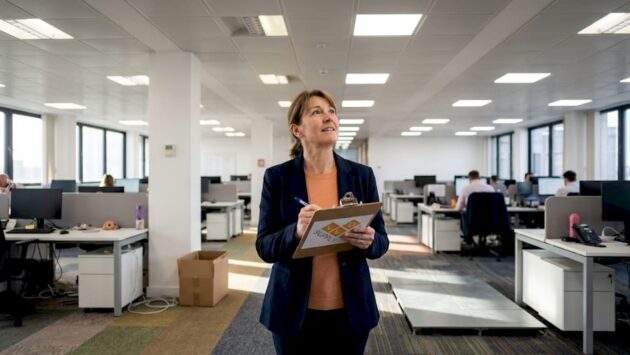
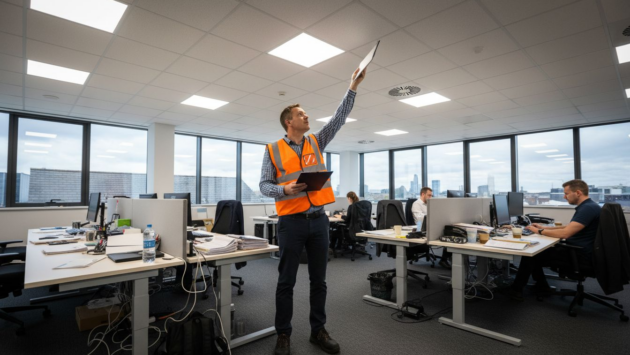
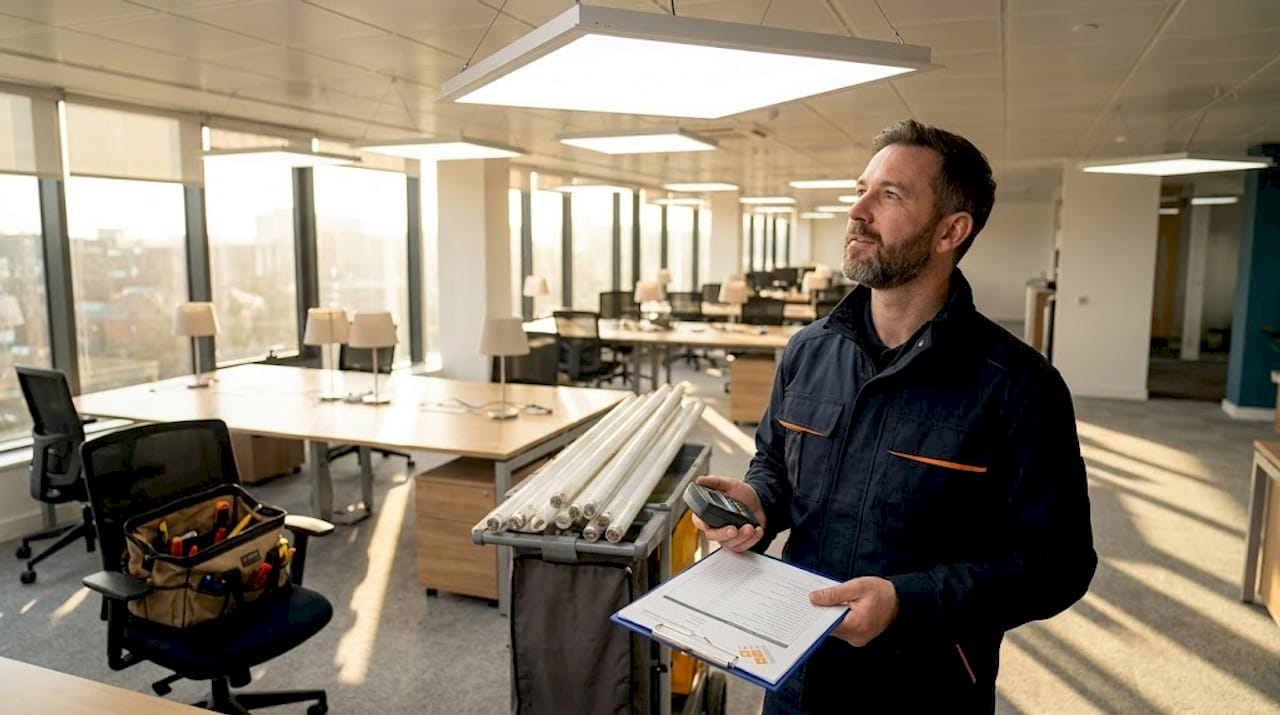
- Conduct a full lighting audit: Walk every area and record existing fixture types, lux readings, ages, and fault history. Note zones where glare complaints or poor task lighting have been raised by staff.
- Map against HSG38 standards: Compare your recorded lux levels against the HSG38 minimums for each zone. Flag any areas falling below 300 lux in general office spaces or below 50 lux in corridors.
- Review your technology mix: Identify any remaining fluorescent, halogen, or incandescent fittings. These are priority replacements for both compliance and cost reasons.
- Specify and procure LED replacements: Use lux calculators or engage a lighting designer to specify the correct luminaire types, quantities, and control systems for each zone.
- Commission the installation: Work with qualified electricians and lighting installers. Ensure all emergency lighting circuits are included in the scope.
- Post-install verification: Measure lux and UGR levels, test emergency lighting to BS EN 1838, and verify that all controls are functioning as specified.
- Establish a monitoring baseline: Record energy consumption immediately after installation. This baseline is essential for calculating real savings and demonstrating ROI to stakeholders.
- Schedule annual reviews: Revisit lux levels, control functionality, and energy data at least once per year. Lamp degradation and space changes affect performance over time.
For a fully structured version of these steps, the detailed LED office lighting checklist resource covers every task in granular detail. You will also find practical LED cost-saving tips that help you maximise return on investment throughout the lifecycle.
Pro Tip: Schedule your post-install lux measurements during a weekend or early morning when the office is unoccupied. Furniture, partitions, and equipment all affect light distribution, so measuring in a clear space gives you a more accurate baseline reading.
Common pitfalls and optimisation opportunities
Even well-intentioned lighting upgrades can fall short if key decisions are rushed or overlooked. These are the most frequent mistakes we see, and the straightforward fixes that resolve them.
Common pitfalls to avoid:
- Ignoring actual lux levels: Assuming that replacing a fluorescent tube with an LED equivalent delivers the same light output without measuring is a costly error. Lumens per watt and beam angles differ significantly between products.
- Bypassing user control: Installing fixed, non-dimmable lighting ignores HSG38 guidance and frustrates staff. Occupant dissatisfaction often leads to workaround behaviours like desk lamps or blinds that undo your savings.
- Neglecting post-install testing: Skipping the verification stage means faults in emergency circuits or poorly aimed fixtures go undetected until a compliance inspection or incident occurs.
- Overlooking colour rendering: A low CRI (Colour Rendering Index below 80) makes office spaces feel flat and can affect mood and alertness, particularly in windowless areas.
- Underestimating glare in open-plan spaces: A high-lumen LED fixture without proper diffusion or baffling can cause worse screen glare than the fluorescent fitting it replaced.
Optimisation opportunities worth acting on:
- Add daylight-linked dimming controls to perimeter zones adjacent to windows. These zones frequently run at full output when natural light already meets the lux requirement.
- Upgrade emergency lighting to LED at the same time as general lighting. This consolidates installation costs and avoids a second mobilisation.
- Use enhancing workplace lighting resources to explore zonal strategies that match lighting intensity to task type rather than treating the whole floor as one zone.
“Businesses that follow expert guidance when upgrading to LED can realistically achieve energy savings of 75-80% against incandescent baselines, with payback periods frequently under three years.”
Good lighting design in offices is one of the most underutilised tools for improving both wellbeing and the bottom line simultaneously.
A fresh perspective on office lighting upgrades
Most lighting checklists stop at installation. Tick the lux box, test the emergency circuit, file the compliance record, and move on. In our experience, that approach leaves the biggest gains on the table.
The real gap in most office lighting upgrades is not a technical specification. It is sustained engagement. Offices where facilities managers actively communicate changes to staff, invite feedback on comfort levels, and visibly act on that feedback consistently outperform those that treat lighting as a set-and-forget infrastructure task. Staff who understand why the lighting changed and who can adjust it locally use less energy overall, because they are not fighting the system.
Reviewing the office lighting experience periodically, rather than annually as a tick-box exercise, catches performance drift early and reinforces the cultural shift that makes energy savings sustainable. The final item on every checklist should read: ask your people how the lighting feels.
Partner with experts for lighting success
Ready to move from checklist to action? Working with a specialist supplier removes the guesswork from specification, procurement, and installation.
At LED Supply and Fit, we support commercial clients across the UK with tailored solutions for offices of every size. Browse our top commercial LED options to compare luminaires, controls, and system packages suited to your space. When you are ready to move forward, request a lighting quote and our team will provide a detailed, no-obligation breakdown covering supply, installation, and projected savings.
Frequently asked questions
What is the recommended lux level for UK offices?
The Health and Safety Executive recommends 300-500 lux for general office areas, with the higher end applying to screen-based and detail-intensive tasks.
How often should office lighting performance be reviewed?
Lighting systems should be reviewed at least annually, as the HSE guidance on post-install verification recommends ongoing monitoring of energy use and lux levels against the original baseline.
Why are smart controls important for office lighting?
Smart controls are now essential for Part L compliance and can reduce lighting energy costs by an additional 20-40% through occupancy sensing, daylight dimming, and scheduled operation.
What should be checked during a post-install lighting review?
Check measured lux and UGR levels against HSG38 targets, test emergency lighting to BS EN 1838, confirm all controls operate correctly, and record energy consumption against the pre-installation baseline.