
Lighting project planning guide: Maximise energy savings with LED
TL;DR:
- Commercial property managers should prioritize LED lighting upgrades to meet increasing energy standards and reduce operational costs. Proper assessment, design, and compliance verification are crucial for maximizing energy savings, EPC improvements, and project ROI. Including controls and thorough verification ensures long-term efficiency and regulatory compliance.
Energy regulations are tightening fast, and commercial property managers who delay their LED lighting upgrades risk both financial penalties and rising operational costs. The Minimum Energy Efficiency Standards (MEES) are pushing EPC requirements upward year on year, and a well-planned LED retrofit is one of the most reliable ways to meet those standards while slashing electricity bills. This guide walks you through every stage of a commercial LED lighting project, from assessing your premises and setting clear goals to executing the installation and verifying the results.
Key Takeaways
| Point | Details |
|---|---|
| LED upgrades boost EPC | LED lighting upgrades can add 5–15 EPC points and help achieve regulatory compliance. |
| ROI within two years | Typical LED retrofit payback periods range from 18 to 36 months. |
| Professional design matters | Expert design and controls maximise both savings and compliance. |
| Retrofit vs. replacement tradeoff | Fixture replacement delivers greater long-term efficiency than simple lamp retrofits. |
| Careful budgeting is essential | Budget beyond the obvious to include installation, controls, and electrical upgrades. |
Assessing your space and compliance requirements
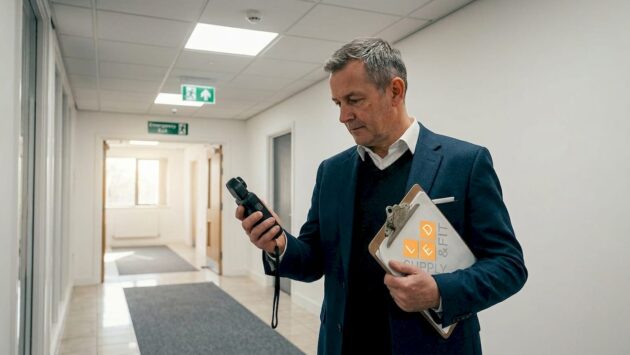
Before ordering a single fixture, you need a clear picture of what you currently have and what the regulations demand. Start by walking your premises with a simple audit sheet. Note every lamp type, wattage, fitting, and approximate age. Fluorescent tubes, metal halide high-bays, and halogen downlighters are the biggest energy wasters in most commercial buildings, and they are the priority targets for replacement.
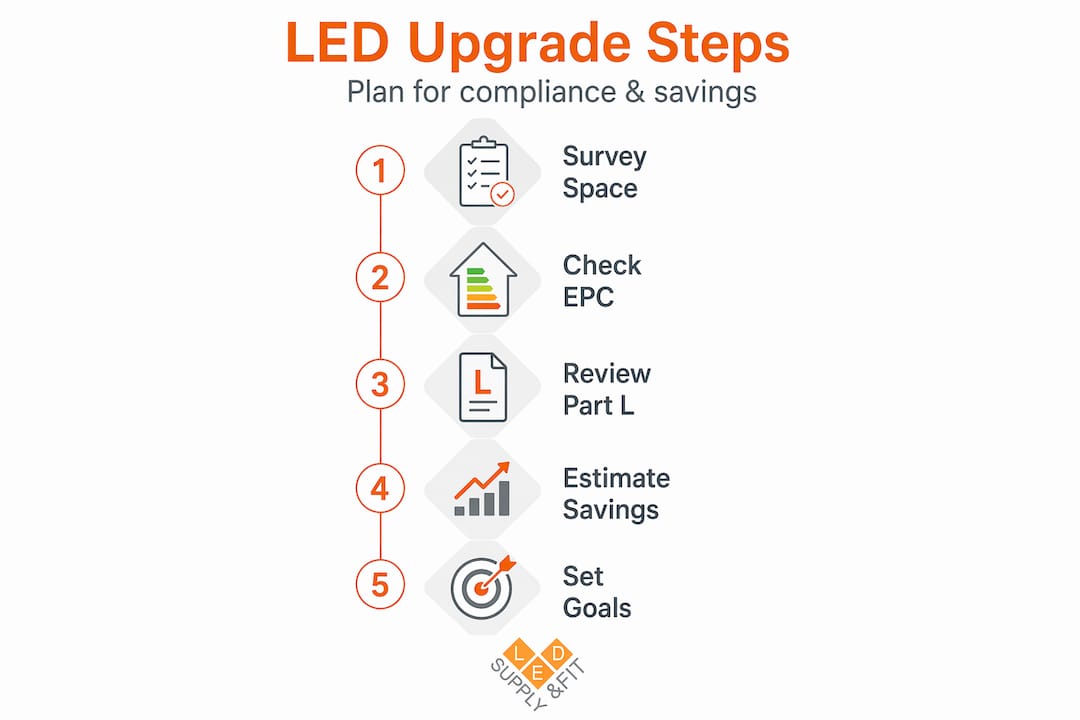
Next, pull your current EPC certificate. UK MEES requirements are rising sharply: commercial lettings need a minimum EPC E rating in 2026, climbing to C in 2027 and B in 2030. LED upgrades can contribute between 5 and 15 EPC points depending on the scale and quality of installation, which means lighting alone could push a marginal property into compliance. Understanding your current rating tells you exactly how much ground you need to cover.
Understanding your UK lighting compliance obligations also means checking building regulations Part L, which governs the energy efficiency of fixed building services including lighting. For large premises, a Display Energy Certificate (DEC) may apply rather than a standard EPC. Do not assume one document covers everything.
| Requirement | Current threshold (2026) | Upcoming threshold | Applies to |
|---|---|---|---|
| MEES EPC rating | Minimum E | C by 2027, B by 2030 | Commercial lettings |
| Building regs Part L | Minimum lamp efficacy 75 lm/W | Under review | New builds and major refurbs |
| Display Energy Certificate | Annual for large public buildings | No change announced | Public sector, large venues |
| WEEE recycling | Mandatory for fluorescent/mercury | Ongoing | All commercial premises |
Common pitfalls at this stage include:
- Ignoring sublet units within your property, which carry their own EPC obligations
- Overlooking emergency lighting compliance under BS 5266 during LED retrofits
- Missing the deadline window for grants or government-backed financing schemes
- Failing to account for listed building restrictions that may limit fixture choices
You can model the future savings from LED before committing to a full project, which makes the business case far easier to present to finance teams or landlords. Much like energy compliance for windows, lighting compliance is increasingly non-negotiable rather than optional.
Setting project goals and scoping your requirements
Once you know your starting point, you need measurable goals. Vague intentions like “reduce energy use” will not serve you when it comes to budgeting, tendering, or reviewing outcomes. Instead, set specific targets: reduce lighting energy consumption by 60%, raise EPC rating from D to C, achieve payback within 24 months, or improve lux levels in the warehouse to 300 lux for task compliance.
Professional lighting design is essential for any project covering more than a handful of rooms. A qualified designer produces a photometric plan that shows actual light levels at working height, not just theoretical lamp outputs. Skipping this step is one of the most expensive shortcuts a property manager can take, because it leads to either over-specification (wasting money on excessive fittings) or under-illumination (failing compliance and productivity benchmarks).
Scoping your project means identifying every component you will need. A solid scope typically includes:
- LED luminaires matched to the application (office, retail, warehouse, hospitality)
- Emergency lighting modules or standalone emergency fittings where required
- Dimming and control systems: PIR sensors, daylight harvesting sensors, DALI controllers
- Cabling and wiring upgrades where existing infrastructure is not rated for new loads
- Safe disposal arrangements for removed fluorescent lamps and ballasts (WEEE regulations apply)
- Qualified electricians holding Part P or JIB-approved credentials
- A project manager or nominated responsible person for compliance sign-off
Combining LEDs with smart controls such as PIR occupancy sensors and daylight harvesting delivers significantly greater savings than LED alone. In fact, controls can add a further 20 to 40 percent reduction on top of the lamp efficiency gains. The lighting design impact on compliance and cost is substantial, so build it into your scope from day one.
Pro Tip: Always budget a contingency of 10 to 15 percent specifically for wiring upgrades and disposal costs. These are the two line items that most frequently cause projects to overspend, and they are rarely included in a basic supply quotation.
Just as energy-efficient glazing works best when specified as part of a wider building improvement programme, lighting upgrades deliver their strongest results when integrated with the building’s overall energy strategy rather than treated as a standalone task.
Step-by-step guide to planning and executing your LED upgrade
A structured sequence prevents costly errors and keeps your project on time and within budget. Here is the process we recommend:
- Conduct a full lighting audit including lamp types, wattages, control systems, and lux measurements at key task areas.
- Commission a photometric design from a qualified lighting designer for any space larger than a single open-plan office.
- Obtain at least three quotations covering supply, installation, controls, and disposal separately so you can compare like for like.
- Secure necessary approvals: building control notification for Part L compliance, landlord consent if applicable, and listed building consent if relevant.
- Schedule phased installation to minimise disruption, particularly in retail or hospitality venues where downtime costs money.
- Arrange WEEE-compliant recycling for all removed fluorescent and discharge lamps before work begins, not as an afterthought.
- Commission and test every fitting, emergency circuit, and control system before the project is signed off.
When it comes to the central decision of lamp retrofit versus full fixture replacement, the choice matters significantly for long-term ROI. Upfront retrofit costs are lower but full fixture replacements yield better efficiency and fewer maintenance issues over a five to ten year horizon.
| Factor | Lamp retrofit | Full fixture replacement |
|---|---|---|
| Upfront cost | Lower | Higher |
| Long-term efficiency | Moderate | Maximum |
| Maintenance requirements | Higher (older housing) | Lower |
| EPC contribution | Moderate | Higher |
| Suitability for compliance | Limited in some cases | Best option |
LED cost-saving strategies consistently show that the payback on full replacements is faster than most managers expect, particularly when energy prices remain elevated. You can explore broader cost-saving LED approaches to see where the biggest gains lie for your type of premises.
Pro Tip: Resist upselling pressure for AI-driven or IoT lighting systems unless your building has genuinely complex, variable occupancy patterns. For a standard office or retail unit, simple PIR and DALI dimming delivers 90 percent of the benefit at a fraction of the complexity and cost.
Important compliance note: All electrical installation work associated with your LED project must be carried out by a Part P-registered electrician or notified to your local authority building control. Failure to certify the work correctly can invalidate your EPC improvement and create liability issues at the point of sale or lease.
Even LED awning and external lighting upgrades follow the same logic: specification, design, installation, and sign-off must be sequential and documented.
Verifying results and avoiding common mistakes
Installation day is not the finish line. Verification is where your investment is confirmed or called into question. Within 30 days of project completion, take lux measurements at the same points recorded in your pre-installation audit. Compare energy meter readings over a four to six week period with the same period from the previous year, adjusted for any occupancy changes.
Request an updated EPC from an accredited assessor once the installation is certified. The benefits of professional LED installation become concrete at this point: a properly designed and installed system will show measurable EPC point gains and real energy bill reductions. Keep all certificates, photometric reports, and electrical installation certificates in a single project file for future reference during audits, sales, or lease renewals.
Combining controls with your LED system is where the most significant additional savings are confirmed post-installation. If your PIR sensors are not triggering correctly or your daylight sensors are miscalibrated, you will not see the full saving. Commissioning checks must include controls testing, not just lamp function.
Common mistakes to avoid at this stage:
- Accepting a project as complete without a lux survey to confirm design intent was met
- Failing to register fluorescent lamp disposal with a licensed WEEE contractor
- Overlooking controls commissioning, leaving sensors in default mode that ignores daylight
- Not updating the asset register with new lamp types and wattages for future maintenance planning
- Skipping the updated EPC, missing the opportunity to document the compliance improvement
LED upgrade payback: Most commercial LED retrofits recover their full investment within 18 to 36 months, after which the energy savings flow directly to your bottom line. For high-usage premises such as warehouses, hotels, and gyms, payback can be even shorter.

Our perspective: What most guides miss about commercial LED upgrades
Most articles about LED lighting projects focus on the lamps. The real complexity is everything around them. In our experience working with commercial clients across the UK, the projects that disappoint are almost always the ones where professional lighting design was skipped to save a few hundred pounds, or where the budget did not account for wiring upgrades and disposal.
The uncomfortable truth is that a box of LED tubes and a willing electrician is not a lighting project. It is a lamp swap. A genuine commercial lighting upgrade requires photometric design, controls integration, compliance documentation, and a clear verification stage. Professional lighting design is not a luxury add-on for large projects. It is the difference between a project that delivers measurable EPC gains and energy savings, and one that simply looks newer.
Expert guidance consistently reinforces that combining LEDs with occupancy and daylight controls is where the real financial case is made. Yet the majority of smaller commercial projects we see have no controls whatsoever. If your lighting runs at full power in an empty building every evening, you have left a significant portion of your investment on the floor.
Budget honestly. Include wiring, disposal, design, commissioning, and a post-installation EPC assessment in your project cost from the start. That is what a real return on investment calculation looks like.
Ready to plan your energy-efficient lighting project?
Planning a commercial LED upgrade is straightforward when you have the right support behind you. The regulatory pressure is real, the savings are proven, and the technology is ready.

At LED Supply and Fit, we work with property managers, business owners, and facilities teams across the UK to specify, supply, and install professional LED lighting systems tailored to your premises and compliance requirements. Whether you are looking for the best commercial LED options for your venue or need guidance on smarter LED solutions that integrate controls and design, our team can help. You can also stay current with sustainable lighting trends to ensure your upgrade positions you well beyond the immediate compliance window. Get in touch to discuss your project today.
Frequently asked questions
How many EPC points can an LED lighting upgrade add?
LED upgrades typically contribute 5 to 15 EPC points, depending on the scale of the project, the quality of the installation, and whether controls are included.
How quickly do LED upgrades pay back their cost?
Most commercial LED retrofits achieve full payback within 18 to 36 months, with high-usage premises such as warehouses and hotels often seeing returns even sooner.
What regulations should I check before starting a project?
Verify your MEES and EPC obligations for your specific property type; commercial lettings require at least an E rating in 2026, rising to C by 2027 and B by 2030.
Is a lamp retrofit or full fixture replacement better for ROI?
Lamp retrofits have lower upfront costs, but full fixture replacements deliver superior long-term efficiency, fewer maintenance demands, and stronger EPC contributions.
Should I use AI or IoT controls for my lighting system?
Skip AI and IoT controls unless your building has complex or highly variable occupancy; straightforward PIR and DALI dimming delivers the best balance of savings and simplicity for most commercial premises.