Top LED lighting maintenance tips for energy savings
TL;DR:
- LED systems last significantly longer, reducing maintenance frequency by up to 80 percent.
- Routine inspections, cleaning, and control checks are essential for maximizing LED lifespan and performance.
- Smart controls like occupancy sensors and daylight harvesting further cut energy use and extend system longevity.
Keeping commercial lighting running efficiently is one of those maintenance challenges that quietly drains budgets before anyone notices. Lamp failures, emergency lighting faults, and reactive call-outs stack up fast when there is no structured approach in place. The good news is that LED technology, when maintained strategically, can slash both your energy bills and your team’s workload. This guide gives you practical, evidence-backed maintenance tips designed specifically for UK facility and maintenance managers who need results, not theory. From understanding system lifespans to smart controls and lifecycle audits, every section here is built to help you get the most from your investment.
Key Takeaways
| Point | Details |
|---|---|
| Track LED system lifespans | Knowing running hours reduces unnecessary replacements and maintenance cost. |
| Follow scheduled upkeep | Routine cleaning and compliance checks help avoid unexpected failures. |
| Use smart controls | Sensors and dimming features can extend LED life and unlock added energy savings. |
| Audit for ongoing savings | Annual audits reveal upgrade and replacement windows for cost control. |
Know your LED system and lifespan
Before you can maintain something properly, you need to understand what you are working with. LED systems are fundamentally different from the fluorescent and HID (high-intensity discharge) fittings many commercial properties still have in service. That difference shapes everything from how often you schedule checks to how you budget for replacements.
The single biggest advantage is longevity. LED lifespan reaches 50,000 to 100,000 hours, reducing maintenance frequency by 60 to 80% compared to fluorescents, which typically last only 8,000 to 15,000 hours. In practical terms, that means far fewer lamp changes, fewer contractor visits, and less disruption to your operations. For a warehouse running lights 16 hours a day, a quality LED fitting could last well over a decade without replacement.
Here is a quick comparison of typical lifespans across common commercial lamp types:
| Lamp type | Average lifespan | Maintenance frequency |
|---|---|---|
| LED | 50,000 to 100,000 hrs | Very low |
| Fluorescent (T8/T5) | 8,000 to 15,000 hrs | High |
| HID (metal halide) | 6,000 to 20,000 hrs | High |
| Halogen | 2,000 to 4,000 hrs | Very high |
Knowing where your site sits on this table helps you plan maintenance cycles with real precision rather than guesswork. The energy savings with LED are well documented, but the maintenance savings are often the bigger surprise for managers used to traditional systems.
To get ahead of failures, log these key components for every major fitting on your site:
- LED drivers: These are the power supply units that regulate current to the LED modules. Driver failure is the most common cause of LED malfunction.
- LED modules: The actual light-emitting components. Note age, wattage, and colour temperature.
- Control gear: Dimmers, sensors, and timers that interact with the system.
- Emergency battery packs: Where fitted, log test dates and battery condition separately.
- Installation date and running hours: Use smart meters or building management system data where available.
Regular audits of system age and condition are what separate reactive maintenance from a genuinely cost-efficient approach. Review your cost-saving LED lighting tips to understand how logging translates directly into budget savings.
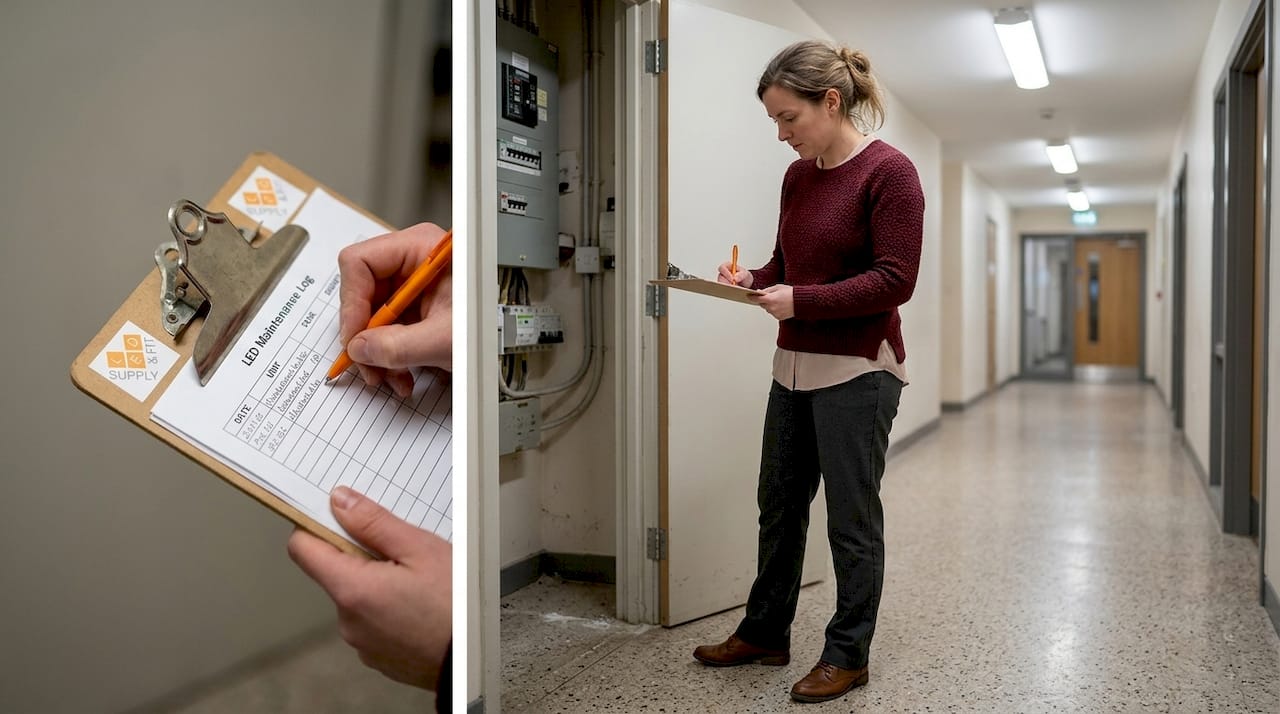
Pro Tip: Create a simple spreadsheet or use your CAFM (computer-aided facilities management) system to log every LED asset, its installation date, and its last inspection. Even a basic record cuts reactive call-outs significantly.
Essential LED maintenance routines for longer life
Once you understand your system, consistent routines are what keep it performing. LED technology is robust, but it is not invincible. Dust accumulation, loose connections, and degraded controls all chip away at performance and efficiency over time.
Here is a practical maintenance sequence to follow across your site:
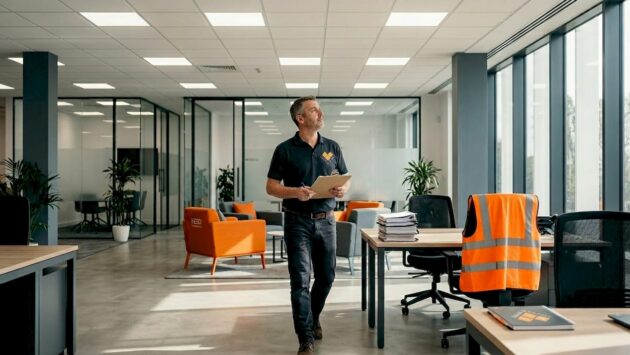
- Monthly visual inspections: Walk each zone and look for flickering, discolouration, or dark spots in luminaires. These are early signs of driver or module degradation.
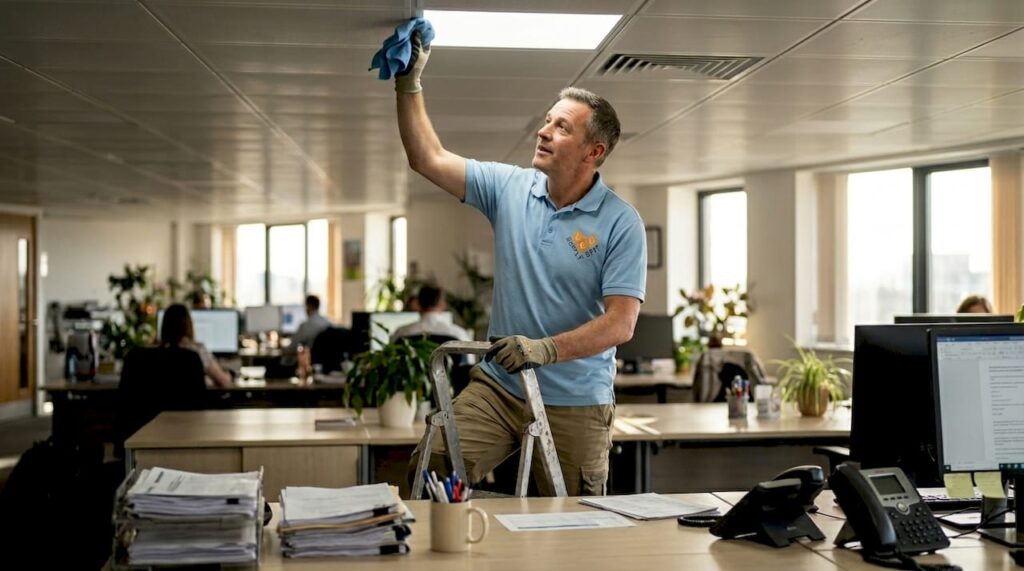
- Quarterly luminaire cleaning: Dust and grime on diffusers and reflectors can reduce light output by up to 30%. Use appropriate cleaning products for the fitting type.
- Bi-annual control checks: Test dimmer response, sensor sensitivity, and timer accuracy. Faulty controls waste energy and accelerate wear.
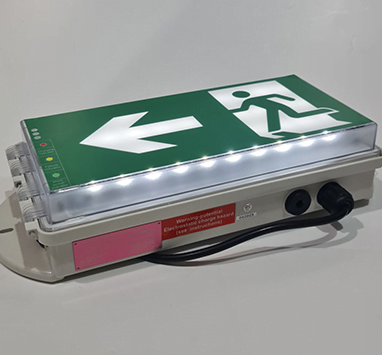
- Monthly emergency lighting function tests: Press the test button on each fitting and confirm the lamp activates and holds for the required period.
- Annual emergency lighting duration test: Run the full discharge test to confirm battery capacity meets the required duration.
That last point is non-negotiable for UK facilities. Emergency lighting must be tested monthly for function and annually for full duration, in compliance with BS 5266-1. Failure to comply is not just a maintenance issue, it is a legal liability.
BS 5266-1 compliance summary: Monthly tests confirm the lamp activates on mains failure. Annual tests confirm the battery sustains the fitting for the full rated duration (typically one to three hours). Both must be logged with dates and outcomes.
For multi-site or large facilities, zone-based maintenance is far more efficient than a site-wide sweep. Divide your building into logical zones (floors, wings, or functional areas) and assign responsibility clearly. This approach means issues are caught faster and accountability is easier to track. Review cost-saving LED routines for more detail on structuring your programme.
Pro Tip: Assign each maintenance zone to a named team member. When one person owns a zone, response times improve and nothing gets missed between visits. Pair this with a simple sign-off sheet for each inspection.
For further guidance on structuring your checks, LED maintenance tips offer a useful reference point for commercial settings.
Maximise efficiency with smart controls and settings
Routine checks keep your system healthy, but smart controls are where the real efficiency gains live. Manual switching is the default in many older commercial buildings, and it is quietly expensive. Lights left on in empty meeting rooms, corridors lit at full brightness overnight, and car parks blazing through the early hours all represent pure waste.
The contrast between manual and sensor-based control is stark:
| Control type | Energy impact | Maintenance benefit | Best suited for |
|---|---|---|---|
| Manual switching | Baseline | None | Low-traffic areas |
| Occupancy sensors | Saves 30 to 50% | Reduces run hours | Offices, corridors, toilets |
| Daylight harvesting | Saves 20 to 40% | Reduces run hours | Perimeter offices, atriums |
| Dimming systems | Saves 10 to 30% | Extends LED lifespan | Retail, hospitality, warehouses |
| Time scheduling | Saves 15 to 35% | Reduces overnight use | Car parks, external lighting |
Using occupancy sensors and dimming can reduce energy consumption by an additional 10 to 70%, and running LEDs at 70 to 80% of their maximum capacity meaningfully extends their operational lifespan. This is a point many managers miss: dimming is not just about ambience, it is a maintenance strategy.
Here are the key control options worth considering for UK commercial facilities:
- PIR occupancy sensors: Reliable and cost-effective for offices and welfare areas.
- DALI (digital addressable lighting interface) systems: Allow granular zone control and fault reporting. Ideal for larger facilities.
- Bluetooth and wireless mesh controls: Lower installation cost, good for retrofit projects where cabling is disruptive.
- Building management system (BMS) integration: Connects lighting to HVAC and access control for whole-building efficiency.
For smarter LED lighting strategies that go beyond basic switching, DALI and BMS integration offer the strongest long-term return. Explore energy reduction methods to see how controls combine with other efficiency measures across your site.
Audit, upgrade, and plan: long-term LED system savings
Controls optimise what you have. Audits tell you whether what you have is still the right fit. For facility managers thinking beyond the next quarter, a structured annual audit is the tool that turns LED investment into sustained financial performance.
Here is a practical annual audit process:
- Record current energy consumption: Pull meter data or sub-meter readings for lighting circuits.
- Map installed assets: Confirm fitting types, ages, wattages, and control types across all zones.
- Identify underperformers: Flag fittings showing lumen depreciation, frequent faults, or outdated technology.
- Calculate lifecycle cost: Compare remaining useful life against replacement cost and projected savings.
- Prioritise upgrades: Focus on the highest-consumption areas first for fastest ROI.
The numbers behind LED upgrades are compelling. LED upgrades reduce energy costs by 50 to 75% and maintenance costs by 60 to 70%, with ROI typically achieved in two to five years. One warehouse case study recorded energy costs dropping from £14,000 to £4,900 per year, a 65% reduction, purely from switching to LED.
| Metric | Before LED upgrade | After LED upgrade |
|---|---|---|
| Annual energy cost | £14,000 | £4,900 |
| Maintenance visits per year | 12 to 18 | 2 to 4 |
| Lamp replacement frequency | Every 1 to 2 years | Every 8 to 12 years |
| ROI timeline | N/A | 2 to 5 years |
Knowing when to repair, retrofit, or fully replace is a judgement call, but lifecycle cost should always drive it. A fitting that costs £80 to repair but has only two years of useful life left is rarely worth the spend. CIBSE and IET guidelines are the recognised standards for UK facility audits, and they consistently point to total lifecycle cost as the correct metric, not upfront price.
For guidance on upgrading commercial lighting and structuring your cost-saving lighting strategies, both resources offer practical frameworks tailored to UK commercial settings.
What most managers overlook in LED lighting maintenance
Here is the uncomfortable truth: the biggest barrier to LED savings is not the technology. It is the assumption that LED is fit and forget. We see it regularly. A facility switches to LED, the energy bills drop initially, and then gradually creep back up. Nobody changed the controls settings after a refurb. The cleaning schedule lapsed. A driver failed and nobody noticed for six months because the zone still had partial light.
LED systems reward active management. The cost saving tips for businesses only deliver their full potential when someone on your team owns the process. That means trained staff who understand what to look for, clear escalation paths when faults appear, and a culture where lighting is treated as a managed asset rather than background infrastructure. The equipment is only half the equation. The other half is the people and processes around it.
Next steps: get expert help and upgrades for your LED systems
If you have read this far, you already know that strategic LED maintenance is not complicated, but it does require the right products, the right controls, and occasionally the right expertise to get the setup correct from the start.
At LED Supply & Fit, we work with facility and maintenance managers across the UK to supply, install, and optimise commercial LED systems built for long-term performance. Whether you need to review your current setup, plan a phased upgrade, or access top commercial LED options suited to your property type, we can help. Explore our cost-saving LED strategies to see how other UK businesses have reduced their energy spend and maintenance burden significantly.
Frequently asked questions
How often should commercial LED lighting be maintained?
Most systems benefit from visual checks at least twice yearly, with emergency lighting tested monthly for function and annually for full duration under BS 5266-1. More intensive use environments may warrant quarterly inspections.
What maintenance savings can LED lighting provide over fluorescents?
LED reduces maintenance frequency by 60 to 80% compared to fluorescents, thanks to lifespans of 50,000 to 100,000 hours versus 8,000 to 15,000 hours for fluorescent tubes.
Can smart controls further reduce LED lighting maintenance?
Yes. Occupancy sensors and dimming cut energy use by 10 to 70% and reduce LED run hours, which directly extends lifespan and reduces the frequency of site visits needed.
What UK standards apply to LED emergency lighting?
UK emergency LED systems must comply with BS 5266-1 requirements, which mandate monthly function tests and annual full-duration discharge tests, with all results logged and retained.