
Why lighting quality matters: save energy and boost wellbeing
Not every LED upgrade delivers the same results. Businesses that switch to LED lighting can reduce energy consumption by 50 to 75% compared to traditional systems, yet many commercial premises see far smaller gains because they prioritise price over quality. The difference between a transformative upgrade and a disappointing one almost always comes down to the specification of the products chosen and the expertise behind the installation. This guide cuts through the confusion, defines what quality actually means in commercial LED lighting, and gives you a practical framework to make the right decisions for your premises and your people.
Key Takeaways
| Point | Details |
|---|---|
| Lighting quality boosts savings | Upgrading to high-quality LEDs can cut energy bills by up to 75% and last much longer than cheap alternatives. |
| Better lighting improves wellbeing | Human-centric lighting supports productivity and staff happiness without raising energy use. |
| Quality standards matter most | Look for low flicker, high colour accuracy, and robust warranties for reliable, futureproof lighting upgrades. |
| Avoid false economies | Saving a little up front on cheap lighting leads to higher long-term costs and disruption for UK businesses. |
The real cost of poor lighting: energy and productivity impacts
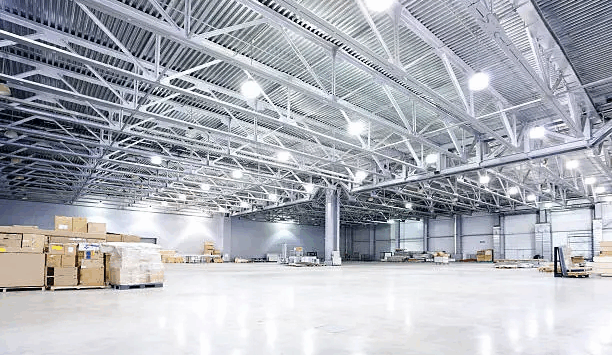
Lighting is one of the most significant overheads in any commercial building. Lighting accounts for 15 to 25% of commercial energy use in UK buildings, which means it represents a substantial slice of your monthly bills. Yet many businesses treat it as an afterthought, buying the cheapest fittings available and assuming the savings will follow automatically. They rarely do.
Poor lighting does not just waste electricity. It creates a cascade of hidden costs that erode profitability in ways that are harder to measure but equally damaging. Staff working under flickering, dim, or poorly distributed light experience increased eye strain, headaches, and fatigue. These are not minor inconveniences. Research consistently links substandard lighting to higher error rates, reduced concentration, and lower morale. In environments such as warehouses, kitchens, or retail floors, errors cost money directly.
The benefits of LED lighting are well established, but they only materialise fully when the right products are installed correctly. A cheap LED panel that flickers at 50Hz or renders colours inaccurately is not a meaningful upgrade from the fluorescent tube it replaced. It may even make things worse.
Consider the numbers. If lighting represents 20% of your energy bill and you achieve only a 30% reduction through a budget upgrade rather than the 70% possible with quality products, you are leaving significant savings on the table every single year. Over a five-year period, that gap compounds into thousands of pounds for a mid-sized commercial premises.
Here are the most common hidden costs of poor lighting that businesses overlook:
- Increased maintenance callouts due to early product failures
- Lost productivity from staff fatigue and discomfort
- Higher absenteeism linked to poor visual environments
- Reputational damage in customer-facing spaces with unflattering light
- Repeat installation costs when cheap fittings fail prematurely
The decision to reduce lighting costs should never begin and end with the unit price of a fitting. The real calculation includes lifespan, maintenance, energy performance, and the effect on the people who work under that light every day.
What makes lighting ‘quality’ in modern commercial spaces?
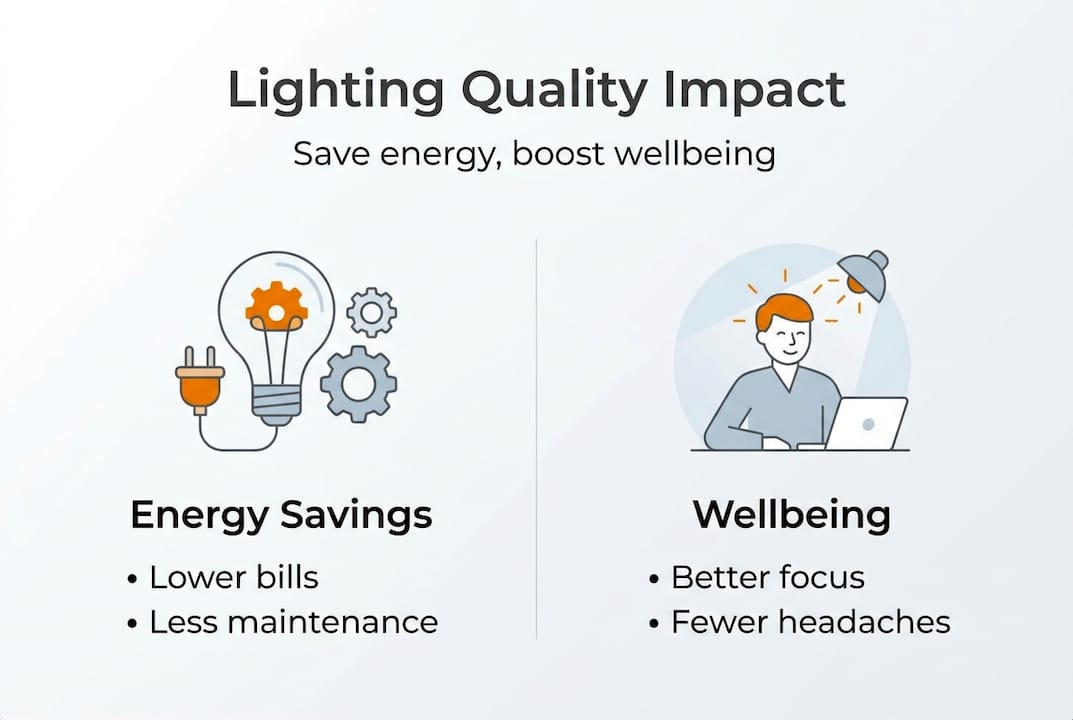
Quality in commercial LED lighting is not a vague concept. It is defined by measurable technical standards that you can and should demand from any supplier. Understanding these metrics puts you in control of the specification process and protects your investment.
The most important factors to assess are:
- Colour rendering index (Rf): Measures how accurately a light source renders colours compared to natural daylight. For most commercial applications, an Rf above 90 is the benchmark for quality.
- Flicker: Poor-quality drivers cause LEDs to flicker at frequencies that, while invisible to the naked eye, cause headaches and eye strain over time. A PstLM value below 1 is the standard to specify.
- Luminous efficacy: Expressed in lumens per watt, this measures how efficiently a fitting converts electricity into light. Quality commercial LEDs typically achieve 120 to 160 lm/W.
- Uniformity: Light should be evenly distributed across a space. Hotspots and dark patches are signs of poor optical design.
- Warranty period: A credible manufacturer backs their product with at least a five-year warranty. Anything less is a warning sign.
Research into lighting strategies for offices confirms that LEDs with high Rf and low flicker deliver lasting value and genuine performance gains. Cutting corners on these specifications is a false economy.
| Feature | Budget generic LED | Quality commercial LED |
|---|---|---|
| Lifespan | 15,000 to 20,000 hours | 50,000 to 75,000 hours |
| Warranty | 1 to 2 years | 5 years or more |
| Colour rendering (Rf) | 70 to 80 | 90 or above |
| Flicker risk | High | Very low |
| Five-year cost | Higher (replacements) | Lower (fewer failures) |
Our LED warranty advice explains what to look for in warranty terms and why the small print matters. Making sustainable lighting choices also means choosing products that will not end up in landfill within three years.
Pro Tip: Always request a photometric report and flicker test data from your supplier before committing to any product. If they cannot provide these documents, look elsewhere.
Human-centric lighting: boosting wellbeing and staff performance
Human-centric lighting (HCL) is the practice of designing light environments that actively support the health and performance of the people within them. It goes beyond energy efficiency to consider how light affects circadian rhythms, alertness, mood, and long-term health.
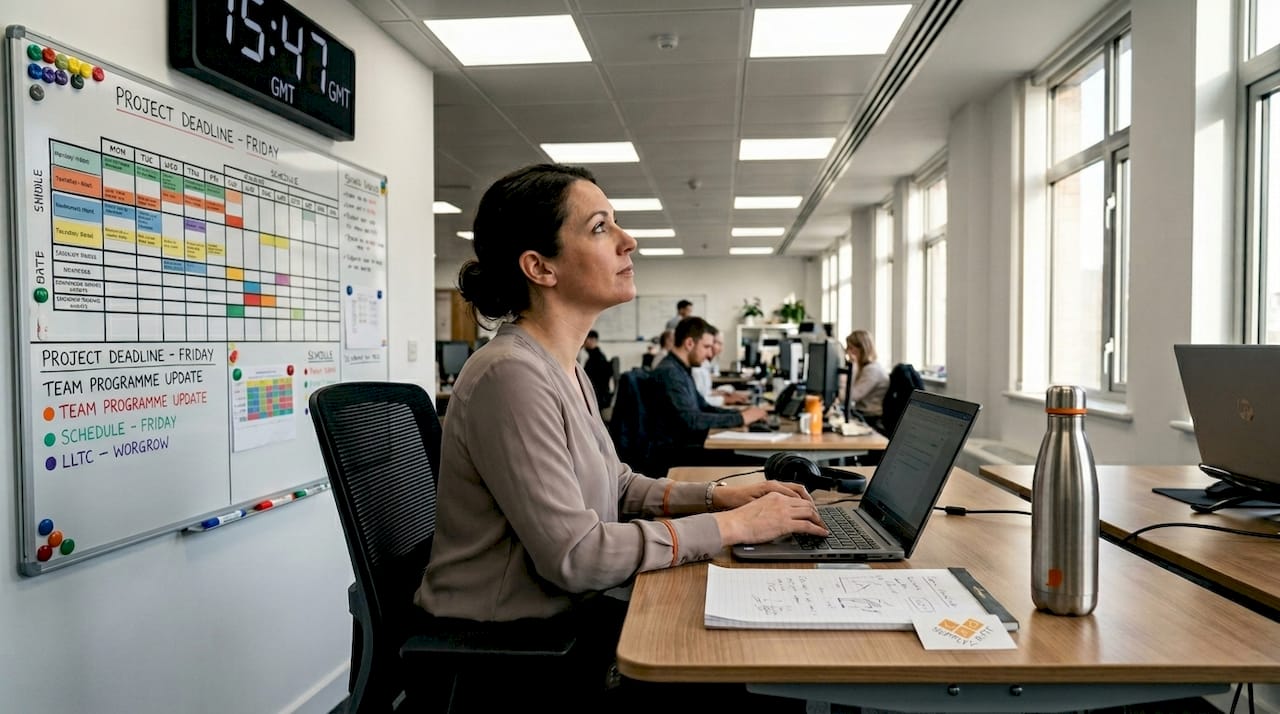
The core mechanism is correlated colour temperature (CCT). Cooler, bluer light (around 5000K to 6500K) promotes alertness and is suited to morning working hours or task-intensive environments. Warmer light (2700K to 3500K) encourages relaxation and is better suited to breakout spaces or end-of-day settings. Dynamic LED systems adjust CCT automatically throughout the day, mimicking the natural shift in daylight.
Human-centric LED lighting using dynamic colour temperatures supports circadian rhythms and measurably improves both wellbeing and productivity in office environments. The benefits for LED installation extend well beyond the energy bill.
| Metric | Static LED (fixed CCT) | Dynamic LED (HCL system) |
|---|---|---|
| Reported eye strain | Moderate to high | Low |
| Staff satisfaction | Average | Significantly improved |
| Absenteeism rate | Baseline | Reduced by up to 15% |
| Error rate (task work) | Baseline | Reduced by up to 10% |
For UK businesses, the practical implications are significant:
- Reduced absenteeism translates directly into lower staffing costs
- Improved alertness reduces costly errors in manufacturing, logistics, and food service
- Better mood and satisfaction contribute to staff retention, cutting recruitment costs
- Customers in retail and hospitality respond positively to well-designed light environments
The compelling aspect of HCL is that these gains do not require more energy. A properly specified dynamic LED system achieves all of this within the same or lower energy budget as a static installation. The investment is in specification and design, not in running costs.
How to specify and implement effective lighting upgrades
A structured approach to your lighting upgrade protects your budget and ensures you achieve the results you are paying for. Here is a straightforward roadmap:
- Audit your current lighting. Document every fitting, its wattage, age, and condition. Identify the worst-performing areas first.
- Set clear performance targets. Aim for a minimum 50% reduction in lighting energy use. Define lux levels required for each area based on the tasks performed there.
- Specify quality standards. Write down your minimum requirements: Rf above 90, PstLM below 1, luminous efficacy above 120 lm/W, and a five-year warranty as standard.
- Choose a reputable installer. Ask for references from comparable commercial projects. Verify that they can provide commissioning documentation and ongoing support.
- Monitor and review. Install sub-metering on your lighting circuits and review performance at three months, six months, and annually.
Research confirms that quality drivers and warranties over five years are essential to securing true savings and avoiding early failures. Our LED cost saving tips and energy saving lighting guidance provide further detail on targeting the biggest wins.
Pro Tip: Never accept a quote that does not include a full product schedule with technical data sheets. Reputable suppliers provide this as standard.
Common pitfalls to avoid:
- Focusing entirely on up-front cost rather than whole-life cost
- Ignoring staff feedback after installation
- Neglecting zoning and controls, which can deliver an additional 20 to 30% energy saving
- Assuming all LED products are equivalent regardless of brand or specification
For a forward-looking view, our guide on future LED lighting trends covers what is coming in commercial lighting technology and how to future-proof your investment. Understanding lighting design considerations for your specific building type is also worth exploring before you finalise any specification.
Why quality beats low cost in lighting upgrades: a hard-won lesson
We have seen the same pattern repeat itself across commercial projects of every size. A business owner, under pressure to control costs, selects the cheapest LED option available. The installation looks fine on day one. Within eighteen months, fittings begin to fail. Colour consistency drifts. Staff start complaining about headaches. The maintenance team is called out repeatedly. Within two to three years, the client is facing a second full upgrade, having spent more in total than a quality installation would have cost from the outset.
Cheap LEDs promise savings but frequently deliver flicker, early failure, and colour distortion. The cost of disruption, repeat installation, and lost productivity erases any initial saving many times over. Upgrading to LED is the right decision, but only when quality is the foundation of that decision.
Pro Tip: Ask any prospective supplier for references from installations that are at least three years old. If they cannot provide them, that tells you everything you need to know.
Investing in quality lighting is not simply about saving money on electricity. It is about managing risk: the risk of early failure, regulatory non-compliance, staff dissatisfaction, and the reputational cost of a poorly lit customer environment. Quality is the only specification that addresses all of these risks simultaneously.
Get expert help for energy-efficient lighting upgrades
If this guide has highlighted gaps in your current lighting setup, the next step is straightforward. At Ledsupplyandfit.co.uk, we work with commercial property managers and business owners across the UK to specify, supply, and install LED lighting that genuinely performs.
Our team can support you with energy audits, full product specification, and warranty-backed installation across offices, retail, hospitality, warehouses, and more. Explore our range of best commercial LED lighting solutions or learn about smarter LED lighting approaches tailored to your sector. Get in touch today to discuss your project and receive expert guidance with no obligation.
Frequently asked questions
What are the main benefits of prioritising lighting quality over cost?
Quality lighting reduces energy bills by 50 to 75%, minimises maintenance frequency, and supports staff wellbeing, delivering lower operational costs across the full lifespan of the installation.
How can I identify a high-quality LED lighting product?
Look for a flicker rating of PstLM below 1, a colour accuracy score of Rf above 90, a minimum five-year warranty, and documented compliance with UK and EU standards.
Does human-centric LED lighting cost more to run?
No. Dynamic LED systems that adjust colour temperature throughout the day can support circadian health and improve productivity without increasing energy consumption when properly specified.
How long should a good quality commercial LED light last?
A well-specified LED fitting with a quality driver and a five-year or longer warranty should deliver 10 to 15 years of reliable service under normal commercial operating conditions.