
Enhance retail performance with effective LED lighting
TL;DR:
- Properly designed LED lighting enhances customer experience and increases sales.
- Switching to LEDs reduces energy costs by up to 80% and lowers maintenance needs.
- UK incentives like tax allowances support affordable store lighting upgrades.
Most shop owners treat lighting as a background detail, something to sort out after the flooring and the signage. That instinct is costing them money. UK retailers who have made the switch to LED lighting are reporting energy bill reductions of up to 80%, sharper product presentation, and measurably better customer dwell time. This guide covers everything you need to know: how lighting directly influences sales, what LEDs actually save you in pounds and pence, which UK government incentives are available in 2026, and the practical steps to upgrade your store without disruption.
Key Takeaways
| Point | Details |
|---|---|
| LEDs save money | Switching to LED lighting can reduce a retail store’s energy costs by up to 80% compared to old systems. |
| Enhance store ambiance | Smart lighting design improves brand perception, customer comfort, and shopping experience. |
| Access UK incentives | UK retailers can use Enhanced Capital Allowances and grants to offset the initial cost of LED upgrades. |
| Quick payback period | Most LED installations pay for themselves in as little as one to four years, through energy and maintenance savings. |
| Strategic asset | Lighting is a silent driver of sales—well-planned LEDs serve both operational and brand goals. |
Why lighting matters in retail environments
Walk into any high-performing retail space and you will notice something before you consciously register it. The atmosphere feels right. Products look appealing. You slow down. That feeling is almost always engineered by lighting, and it works on your customers in exactly the same way.
Lighting is one of the most powerful tools you have for shaping shopper behaviour. Research consistently shows that well-lit retail environments encourage customers to browse longer, perceive products as higher quality, and spend more. Poor lighting, by contrast, creates a discount-store feeling regardless of what you are actually selling. The psychological impact is real and measurable.
Three technical factors drive this effect:
- Colour temperature sets the mood. Warm white light (around 2700K to 3000K) suits boutiques, bakeries, and homeware shops. Cool white (4000K to 5000K) works better in electronics, pharmacies, and workwear retailers.
- Brightness and contrast guide the eye. Highlighting key products with focused accent lighting draws customers toward your best-margin items naturally.
- Placement and direction define how spaces feel. Uplighting creates drama. Diffuse overhead lighting creates calm. Layering both gives you control over the entire customer journey.
These are not abstract design principles. They are commercial levers. A fashion retailer using high-CRI (Colour Rendering Index) LEDs to show garment colours accurately will outsell a competitor using old fluorescent tubes that wash everything out. If you want to design retail lighting that genuinely supports your sales targets, colour temperature and CRI should be your starting points.
“LED lighting reduces energy costs by 50 to 80% compared to traditional sources, with payback in 12 to 48 months, and reduces HVAC load by 10 to 20%.”
That statistic matters beyond the energy bill. Lower heat output from LEDs means your air conditioning works less hard in summer. Your staff are more comfortable. Your products, particularly food, cosmetics, and textiles, are less affected by heat damage. Lighting is not just ambiance. It is infrastructure.
LED lighting: Cost, efficiency and sustainability benefits
Let us get into the numbers, because this is where the business case becomes undeniable.
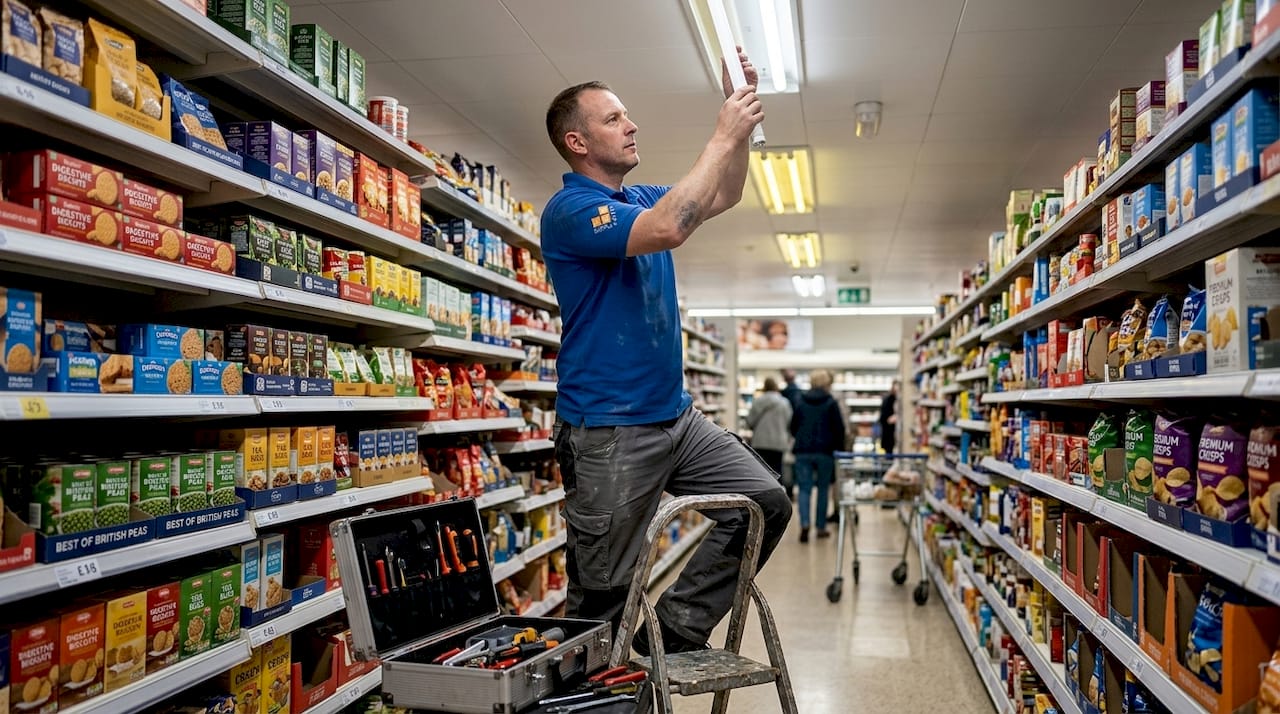
Traditional fluorescent and halogen fittings are expensive to run and even more expensive to maintain. A typical 58W fluorescent tube costs around three to four times more to operate annually than its LED equivalent. Halogen spotlights are worse. They burn hot, fail frequently, and require regular replacement, which means ongoing maintenance labour costs on top of the energy bill.
LEDs flip that equation entirely. A quality commercial LED fitting typically lasts 50,000 hours or more, compared to 2,000 hours for a halogen bulb. That is a dramatic reduction in replacement frequency and maintenance visits.
| Lighting type | Typical lifespan | Energy use (relative) | Maintenance frequency |
|---|---|---|---|
| Halogen | 2,000 hours | High | Very frequent |
| Fluorescent | 8,000 to 15,000 hours | Medium | Occasional |
| LED | 50,000+ hours | Low | Rare |
For a medium-sized retail unit running lights for 12 hours a day, the shift to LEDs can mean cutting costs with LEDs by thousands of pounds per year. Payback periods typically range from 12 to 48 months, meaning most stores recover their investment well within the lifespan of the fittings.
The energy savings with LED technology also extend to your HVAC system. Because LEDs emit far less heat than traditional sources, your cooling system does not have to compensate as hard during warmer months. That 10 to 20% reduction in HVAC load is a genuine secondary saving that many retailers overlook entirely when calculating ROI.
Pro Tip: To estimate your store’s savings, multiply your current lighting wattage by your daily operating hours and your electricity unit rate (pence per kWh). Then do the same calculation with your proposed LED wattage. The difference is your annual saving. Most retailers are surprised by how quickly the numbers stack up.
The sustainability benefits of LEDs also matter for brand positioning. Customers increasingly notice and reward businesses that take environmental responsibility seriously. Lower energy consumption, longer product life, and reduced waste all contribute to a smaller carbon footprint, which is something worth communicating to your customers.
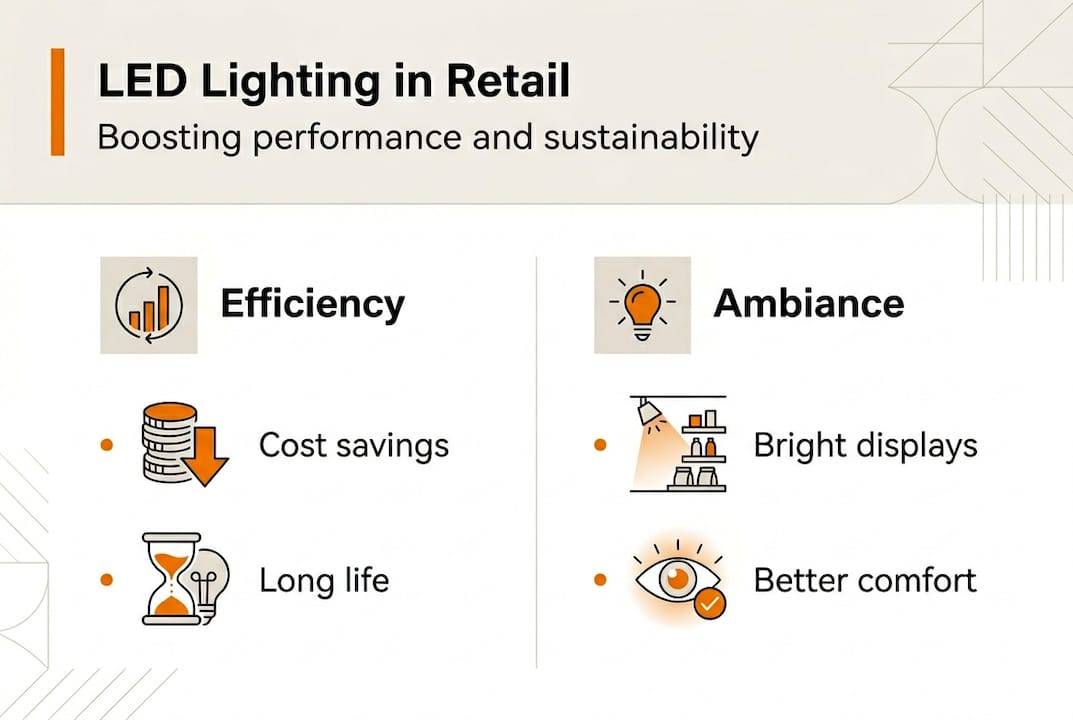
How lighting shapes store ambiance and customer experience
Efficiency is one half of the LED story. The other half is what great lighting does for the way your store feels.
Customers make emotional decisions. They decide within seconds whether a shop feels like somewhere they want to spend time. Lighting is the fastest and most controllable way to shape that first impression. Here is a practical sequence for upgrading your store’s ambiance through LED lighting:
- Audit your current lighting zones. Walk your store as a customer would. Note where it feels flat, harsh, or uninviting. These are your priority areas.
- Define your brand feel. Luxury brands benefit from warm, focused lighting. Active and sports retailers suit brighter, cooler tones. Match the light to the message.
- Layer your lighting. Combine ambient (general overhead), accent (product spotlights), and task (checkout, fitting rooms) lighting for a professional result.
- Install dimmable LEDs. Being able to adjust brightness throughout the day, brighter during peak hours, softer in the evening, gives you flexibility without additional fittings.
- Choose high-CRI LEDs for product displays. A CRI of 90 or above ensures colours look accurate and appealing under your lights, which directly affects purchase decisions.
- Review and adjust after installation. Walk the space again. Check sightlines, shadows, and how key products appear. Small adjustments at this stage make a significant difference.
For designing for ambiance that genuinely reflects your brand, the colour temperature of your LEDs is the single most important decision. Get it wrong and even an expensive fit-out can feel cheap.
Pro Tip: One of the most common ambiance mistakes is overlighting. Flooding every corner of a shop with maximum brightness eliminates contrast, which is what makes products stand out. Controlled shadow and highlight are your friends. Retailers who invest in LED types suited to their specific zones consistently report better customer feedback than those who use a one-size-fits-all approach.
Securing UK incentives and financing for LED upgrades
Once you have decided to upgrade, the next question is how to fund it. The good news is that the UK government offers several mechanisms to reduce the upfront cost of LED installation for commercial properties.
The main options available in 2026 are:
- Enhanced Capital Allowances (ECA): This scheme allows businesses to deduct 100% of qualifying costs in the first year of purchase. For a retailer spending £20,000 on LED fittings, that is a full first-year tax deduction, significantly improving cash flow.
- Business Energy Advice Service (BEAS) grants: BEAS grants can fund up to 50% of eligible project costs, with grants reaching up to £100,000. These are designed specifically for small and medium-sized businesses making energy efficiency improvements.
- Energy Company Obligation (ECO): The ECO scheme supports energy upgrades through energy suppliers. Eligibility varies, but it is worth checking with your supplier directly.
| Incentive | Maximum benefit | Who qualifies | Application route |
|---|---|---|---|
| Enhanced Capital Allowances | 100% first-year deduction | Most UK businesses | Via self-assessment or corporation tax return |
| BEAS grants | Up to £100,000 (50% funded) | SMEs in eligible sectors | Through BEAS portal |
| ECO scheme | Variable | Businesses meeting energy criteria | Via energy supplier |
To prepare a strong application for any of these schemes, you should gather the following:
- Current energy bills showing your baseline consumption
- Quotes from qualified LED installers
- Details of the products you plan to install (efficiency ratings, wattage)
- Evidence of your business type and size
For practical LED cost-saving tips and guidance on reducing lighting costs through available schemes, it is worth reviewing what other UK retailers have done before you. The application processes are more straightforward than many business owners expect, and the financial impact can be substantial.
A fresh perspective: Why lighting is your silent salesperson
Here is something most lighting guides will not tell you. The retailers who get the best results from LED upgrades are not the ones who focused purely on energy savings. They are the ones who treated lighting as a sales tool.
We have seen too many shop owners invest in LEDs, tick the efficiency box, and then wonder why footfall has not improved. The reason is usually that they chose the cheapest fittings with no thought for colour temperature, CRI, or zoning. They saved money on energy and spent it back on a flat, uninspiring customer experience.
The role of LEDs in cost reduction is real and significant. But the deeper value lies in what good lighting does to how customers feel in your space. It builds trust. It signals quality. It makes your products look like they are worth what you are charging for them. That is not a soft benefit. That is margin.
The retailers winning in 2026 are treating lighting as a strategic layer of their brand, not a utility bill to minimise.
Upgrade your retail lighting—see the difference
If this article has shifted how you think about your store’s lighting, the next step is straightforward. Explore our range of top LED retail lighting products, designed specifically for commercial environments where performance and presentation both matter.
Our team works with retail businesses across the UK, from single-unit independents to multi-site operators, helping them choose and install smarter LED lighting that delivers on ambiance and efficiency. We offer next-day delivery, bulk pricing, and free initial consultations. Whether you are starting from scratch or replacing outdated fittings, we can help you get it right the first time. Get in touch today and let us show you what the right lighting can do for your store.
Frequently asked questions
What are the real energy savings from switching to LED lighting in my shop?
UK retailers typically save between 50 to 80% on energy costs related to lighting, with some stores achieving payback in as little as 12 months depending on their current setup.
How do I qualify for UK government incentives for LED lighting?
You can access incentives like Enhanced Capital Allowances and BEAS grants by meeting the relevant scheme criteria and applying through official UK channels, usually with support from your accountant or installer.
Will LED lighting affect my store’s heating and air conditioning needs?
Yes. LEDs generate significantly less heat than traditional fittings, often reducing HVAC load by 10 to 20%, which cuts your cooling costs alongside your lighting bill.
Which LED lighting features should I prioritise for improving store ambiance?
Focus on adjustable colour temperature, a CRI of 90 or above, dimmable fittings, and clearly defined lighting zones. These four elements have the greatest impact on how your store feels to customers.
How soon will I see a return on investment after installing LEDs?
Most UK retailers recoup their investment within one to four years, driven by energy and maintenance savings that begin from the first month of operation.