

Emergency LED lighting: safe, efficient solutions for UK businesses
TL;DR:
- Modern emergency LED lighting offers significant energy savings and reduces maintenance costs.
- It activates instantly during power failures, ensuring safe evacuation routes in various commercial settings.
- Compliance with BS5266-1:2025 is essential, requiring full route coverage and regular testing.
Not all emergency lighting is created equal. Many UK commercial premises still run on ageing fluorescent or incandescent emergency systems that drain energy, demand constant maintenance, and may no longer meet current regulations. Modern emergency LED lighting changes that equation entirely. Commercial upgrades to LED can reduce energy usage by up to 65% and cut maintenance costs by 70%, making this far more than a safety box-tick. This guide explains exactly what emergency LED lighting is, how it works, and how property managers and business owners across the UK can use it to protect people, cut costs, and stay fully compliant.
Key Takeaways
| Point | Details |
|---|---|
| Efficiency and savings | Switching to emergency LED lighting typically reduces both energy and maintenance costs by over 50% for UK businesses. |
| Critical compliance | Upgrading ensures full legal compliance and insurance validity under UK regulations like BS5266-1:2025. |
| Safety enhancement | Modern LED systems protect staff and visitors by guaranteeing reliable illumination during power loss. |
| Simple implementation | A clear, step-by-step process helps businesses quickly assess, specify, and install compliant emergency LED solutions. |
What is emergency LED lighting?
Emergency LED lighting is a self-contained or centrally powered lighting system that activates automatically when the main power supply fails. Unlike standard lighting, it does not rely on the building’s normal electrical circuit. When a power cut or fault occurs, the system switches on within seconds, illuminating escape routes and key areas so occupants can evacuate safely.
You will find emergency LED lighting in use across a wide range of commercial settings:
- Exit routes and corridors in offices, retail units, and hotels
- Stairwells and fire doors in multi-storey buildings
- High-risk machinery zones in warehouses and manufacturing facilities
- Large open spaces such as gyms, event venues, and supermarkets
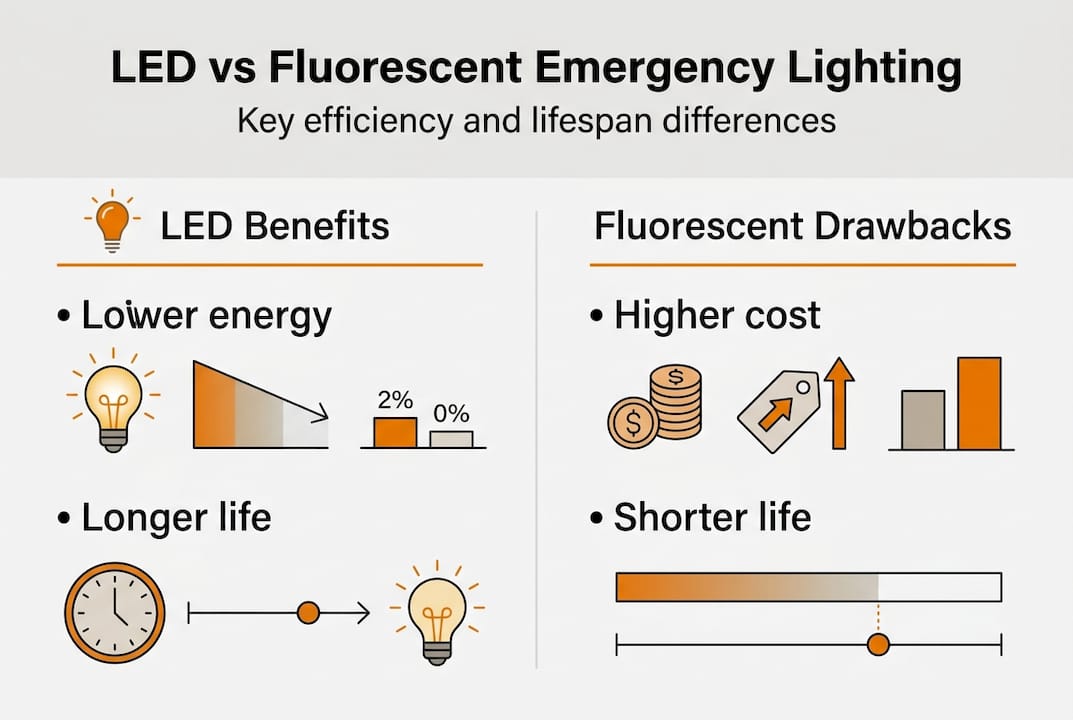
Compared to older fluorescent and incandescent emergency systems, LED luminaires respond faster, last significantly longer, and require far less maintenance. A traditional fluorescent emergency fitting might need its battery replaced every three to four years and its lamp every two. An LED equivalent can operate for 50,000 hours or more, with far fewer interventions.
The legal context matters here. UK businesses must comply with BS 5266 emergency lighting guidelines, which set out the minimum standards for emergency lighting in non-domestic premises. The updated BS5266-1:2025 standard is particularly significant: it requires full escape route coverage across the entire width of the route, not just the centre, and explicitly bans reliance on spill light from adjacent areas. This is a meaningful shift from older interpretations, and many existing installations do not yet meet it.
Pro Tip: If your current emergency lighting was installed before 2020, it is worth commissioning a photometric review to check whether it meets the 2025 standard. Non-compliance can affect your insurance and expose you to enforcement action.
The practical implication is clear. Businesses that upgrade to emergency LED lighting are not just improving safety. They are future-proofing their premises against tightening regulation, reducing their energy footprint, and cutting the operational burden of maintaining ageing systems.
How emergency LED lighting systems work
Understanding how these systems function helps you make smarter decisions about specification and installation. An emergency LED lighting system has four core components: LED luminaires, battery packs (either self-contained within each fitting or in a central battery unit), test circuits, and a control or monitoring panel.
During normal operation, the battery pack charges continuously from the mains supply. When power fails, the system detects the loss within milliseconds and switches the luminaires to battery power. In a commercial warehouse, for example, this means conveyor lines and machinery can be shut down safely while workers evacuate via clearly lit routes. In a hotel corridor, guests can find the nearest fire exit without panic.
Here is how emergency LED systems compare to older fluorescent alternatives:
| Feature | Emergency LED | Fluorescent emergency |
|---|---|---|
| Lifespan | 50,000+ hours | 8,000-15,000 hours |
| Energy consumption | Very low | Moderate to high |
| Maintenance frequency | Low | High |
| Response time | Instant | Slight delay |
| Compliance with BS5266-1:2025 | Achievable | Often inadequate |
| Battery replacement cycle | 6-10 years | 3-4 years |
Failures in legacy emergency lighting often stem from battery degradation and reliance on spill light, neither of which is acceptable under current standards. LED systems with modern lithium or NiMH battery technology hold charge more reliably and degrade more slowly.
For high-risk zones such as plant rooms or areas with heavy machinery, escape route coverage requirements mandate circuit diversity, meaning the emergency lighting must be fed from at least two independent circuits so a single fault cannot black out the entire area.
Pro Tip: Choose luminaires with built-in self-test functionality. These automatically run monthly and annual tests and log the results, saving your facilities team hours of manual testing time each year.
Energy and maintenance savings: business case for upgrading
Understanding the technology is vital, but what about the bottom line? Let’s look at the business case.
The numbers are compelling. UK commercial upgrades to LED save 50 to 70% on energy, and a typical warehouse can see its annual electricity bill drop from £14,000 to £4,900, with maintenance costs falling by 70%. Emergency lighting is a smaller portion of the overall estate, but the same principles apply proportionally.
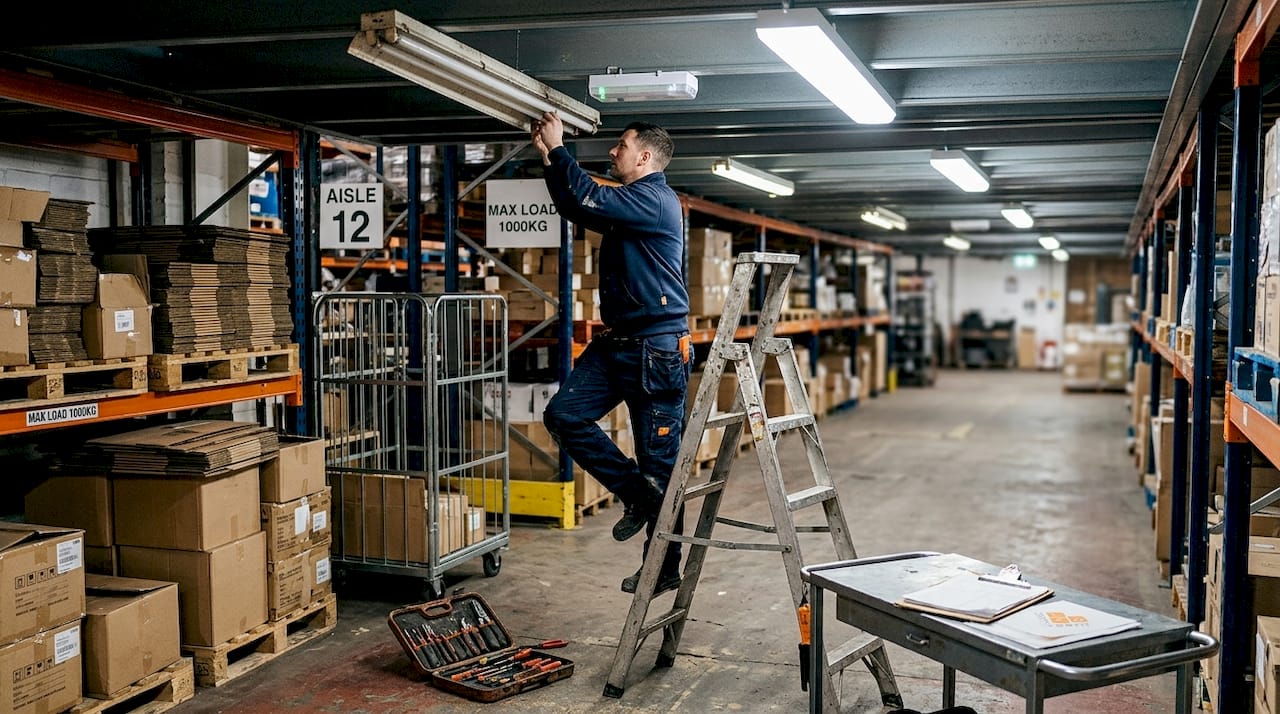
Here is a simplified example of what upgrading emergency lighting might look like across three common commercial property types:
| Property type | Estimated annual energy saving | Estimated maintenance saving | Approximate payback period |
|---|---|---|---|
| Retail unit (1,000 sq ft) | £300-£600 | £200-£400 | 2-3 years |
| Office building (5,000 sq ft) | £800-£1,500 | £500-£900 | 3-4 years |
| Warehouse (20,000 sq ft) | £2,500-£5,000 | £1,500-£3,000 | 2-4 years |
These figures reflect energy reduction alone. When you factor in fewer call-outs, reduced lamp and battery replacements, and the avoided cost of compliance failures, the return on investment becomes even stronger. Exploring top LED cost-saving strategies and reviewing cost saving tips specific to your sector can sharpen these projections further.
Here is a straightforward way to think about the upgrade decision:
- Calculate your current emergency lighting energy spend (check your last 12 months of electricity bills)
- Estimate replacement and maintenance costs over the same period
- Get a quotation for a compliant LED upgrade
- Divide the total upgrade cost by your combined annual savings to find your payback period
“Businesses that treat emergency lighting as a cost centre are missing the point. It is an investment with a measurable return, and the payback period is often shorter than most managers expect.”
Compliance also has a direct financial dimension. An emergency lighting failure that contributes to an incident can void your insurance policy or result in enforcement action from the Health and Safety Executive. Keeping your system current and documented is not just good practice; it protects your business financially.
Compliance and common mistakes to avoid
Maximising savings means nothing without meeting your legal and insurance responsibilities.
BS5266-1:2025 is the current benchmark for emergency lighting in UK commercial premises. The key requirements include full illumination of the entire escape route width, circuit diversity for high-risk zones, and a clear ban on relying on spill light from adjacent rooms or fittings. Battery degradation and poor placement are cited as the most common causes of non-compliance, and both are avoidable with modern LED systems.
The testing schedule is non-negotiable:
- Monthly: A brief functional test to confirm each unit activates
- Annual: A full rated duration test (typically three hours) to verify battery capacity
- Every five years: A full photometric verification to confirm lux levels across all escape routes
The most common pitfalls we see in commercial premises include:
- Missed or undocumented monthly tests
- Batteries that have degraded beyond their rated capacity without replacement
- Layouts that have not been updated after internal refurbishments
- Reliance on borrowed light from adjacent spaces
- No record of the original photometric design
Any one of these can render your installation non-compliant with UK LED standards and, critically, can invalidate your insurance in the event of an incident. Insurers increasingly ask for evidence of testing records and compliance documentation during claims.
Pro Tip: Keep a dedicated emergency lighting logbook on-site. Record every test, every fault, and every remedial action. If you are ever audited or face a claim, this documentation is your first line of defence.
Statistic to note: Businesses that upgrade to compliant LED systems and maintain proper testing records report significantly fewer enforcement notices and insurance disputes than those running legacy systems.
How to choose and implement emergency LED lighting
With compliance in mind, here is a clear action plan to choose and install the right system.
-
Conduct a site survey. Walk every escape route, stairwell, and high-risk area. Map all exits, changes in direction, and zones where machinery or equipment is present. Note ceiling heights and any obstructions that could affect light distribution.
-
Map required lux levels. BS5266-1:2025 specifies minimum lux levels for different areas. Escape routes require at least 1 lux at floor level along the centre line, with 0.5 lux across the full route width. High-risk task areas require a minimum of 10% of normal task illuminance.
-
Select compliant LED products. Look for luminaires carrying verifiable UK compliance marks and photometric data from an accredited laboratory. Avoid products that cannot supply independent test data.
-
Specify dual-circuit setups for high-risk areas. Photometric checks every five years and circuit diversity upgrades prevent single-fault disasters in your most critical zones.
-
Plan your installation and testing schedule. Work with your installer to agree a commissioning date, a handover document pack, and a forward testing calendar. Make sure your facilities team understands the monthly test procedure.
-
Review and update after any refurbishment. Any internal layout change can affect emergency lighting coverage. Treat a refit as a trigger for a new photometric review.
Understanding the role of LEDs in cost reduction will help you frame the investment conversation internally and get sign-off from finance teams who may not yet see emergency lighting as a strategic priority.
Pro Tip: Work with installers who provide full commissioning documentation, including photometric reports and circuit diagrams. This paperwork is essential for five-year verification and insurance purposes.
Why smart emergency LED upgrades are more than just a safety tick box
Most businesses approach emergency lighting as a grudging legal expense. They do the minimum, file the paperwork, and move on. That mindset is understandable, but it leaves significant value on the table.
A proactive upgrade to modern emergency LED lighting signals something important to your staff, your clients, and your insurers: that you take operational resilience seriously. The best UK LED options available today are not just compliant; they are genuinely better assets. They reduce your carbon footprint, improve your ESG reporting, and demonstrate a commitment to workplace safety that goes beyond the minimum.
We have seen businesses use a full LED emergency lighting upgrade as part of a wider sustainability narrative, communicating it to customers and stakeholders as evidence of responsible management. That is a return on investment that does not show up in an electricity bill but is no less real. The right emergency LED system is not a cost. It is a business asset.
Secure your business with industry-leading emergency LED lighting
If your premises are still running on ageing emergency lighting, every month of delay is costing you money and increasing your compliance risk. The good news is that upgrading is more straightforward than most property managers expect, and the returns are measurable from the first year.
At Ledsupplyandfit.co.uk, we supply and install best emergency LED lighting solutions designed specifically for UK commercial premises, from small retail units to large warehouses. Our range of energy-saving LED solutions covers every compliance requirement under BS5266-1:2025, with full documentation and installation support included. Get in touch with our team to arrange a site consultation and find out exactly what your upgrade would cost and save.
Frequently asked questions
Do all commercial properties in the UK need emergency LED lighting?
Yes, UK law under BS5266-1:2025 requires adequate emergency lighting in all non-domestic premises to ensure safe evacuation during a power failure. Full escape route coverage is mandatory, not optional.
How often should emergency LED lighting be tested?
Monthly function tests and a full annual duration test are required as a minimum; photometric performance must be verified every five years to confirm lux levels remain compliant.
How much can switching to emergency LEDs really save?
UK businesses can reduce energy use by 50 to 70% and cut maintenance costs by up to 70%, with payback periods typically falling between two and five years depending on premises size.
What is the most common compliance mistake with emergency LED lighting?
Relying on spill light or failing to illuminate the full escape route width are the most frequent causes of non-compliance, both of which can invalidate your insurance and trigger enforcement action.