Sustainable lighting trends: save costs and stay compliant
TL;DR:
- LED lighting significantly reduces energy costs and maintenance expenses compared to traditional systems.
- Smart controls enhance LED efficiency, enabling further savings through occupancy and daylight sensors.
- Upgrading to LED improves EPC ratings, supporting compliance with MEES regulations and sustainability certifications.
LED lighting reduces energy consumption by 50–85% compared to traditional fluorescent and halogen systems, and in 2026 that figure matters more than ever for UK commercial property managers. With MEES regulations now requiring a minimum EPC rating of E for lettable commercial premises, the pressure to act is no longer theoretical. Rising energy costs, tightening sustainability targets, and growing tenant expectations are converging into a single, urgent question: is your lighting holding your property back? This article walks through the core benefits of sustainable lighting, the technologies driving further savings, the compliance landscape, and real-world results from businesses that have already made the switch.
Key Takeaways
| Point | Details |
|---|---|
| Major energy savings | LED lighting and smart controls can cut commercial property energy use by up to 85% and more. |
| Rapid payback | Most businesses recoup LED upgrade costs in two to four years through reduced energy and maintenance bills. |
| Compliance boost | LED upgrades help properties achieve MEES and EPC requirements, improving sustainability credentials. |
| Cut maintenance hassles | LEDs last many times longer than traditional lamps, reducing the frequency and expense of replacements. |
| Holistic optimisation | Combining audits, smart controls, and user-focused design delivers the highest lighting performance and ROI. |
Understanding sustainable lighting: key benefits over traditional systems
The case for switching away from fluorescent, halogen, and incandescent systems is not simply about being green. It is about hard financial logic. When you upgrade to LED, you are fundamentally changing the economics of how your building operates.
The most immediate benefit is energy consumption. LED systems cut energy use by 50–85% compared to traditional alternatives. For a mid-sized office or retail unit running lights for 10 to 12 hours a day, that reduction translates directly into hundreds or thousands of pounds off your annual electricity bill. The savings are not marginal.
Lifespan is the second major advantage. LEDs last 50,000+ hours, which is five to seven times longer than standard fluorescent tubes. In practical terms, that means dramatically fewer replacement cycles, less time spent on maintenance call-outs, and lower labour costs over the life of the installation. For warehouse or industrial settings where accessing ceiling fittings requires scaffolding or specialist equipment, this difference is enormous.
Environmentally, the shift matters too. Fluorescent lamps contain mercury, a hazardous substance that requires careful disposal under UK waste regulations. LEDs contain no mercury, simplifying your compliance obligations and reducing environmental risk. When you reduce lighting costs through LED adoption, you are simultaneously reducing your carbon footprint and your exposure to hazardous waste handling.
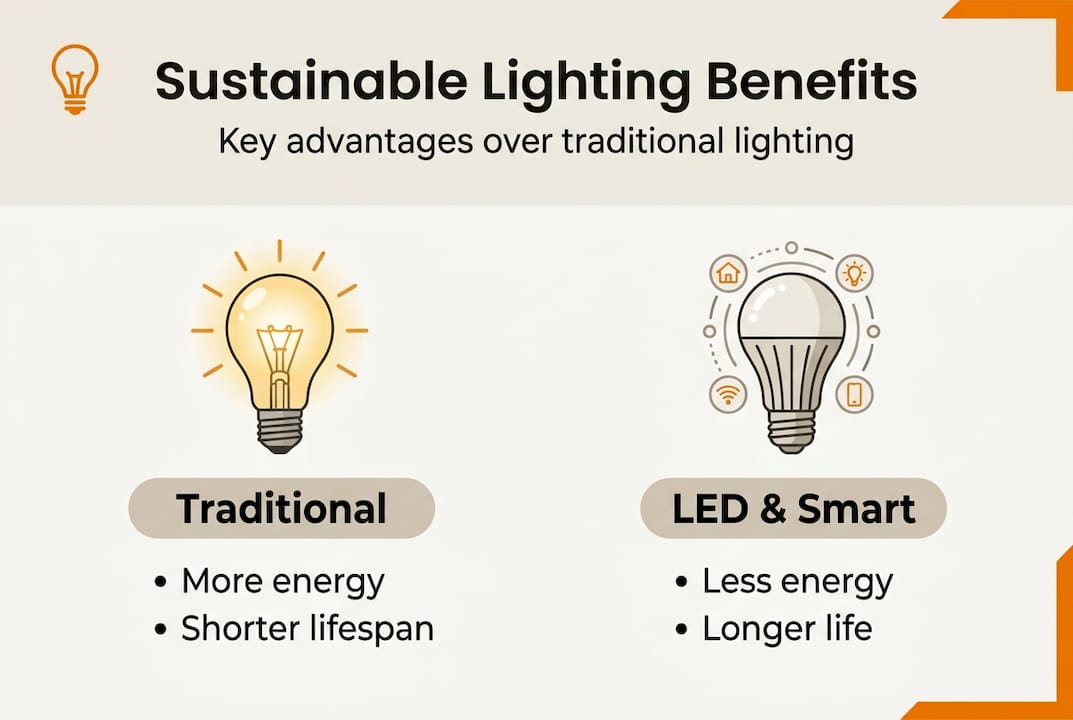
Here is a direct comparison of the two technologies:
| Feature | Traditional fluorescent | LED |
|---|---|---|
| Energy consumption | Baseline (100%) | 15–50% of baseline |
| Typical lifespan | 8,000–20,000 hours | 50,000+ hours |
| Mercury content | Yes | No |
| Maintenance frequency | High | 5–7x less frequent |
| Upfront cost | Lower | Higher (lower lifecycle cost) |
The upfront investment in LED is higher, and that is worth acknowledging honestly. But when you factor in energy savings, reduced maintenance, and longer product life, the lifecycle cost picture reverses decisively in LED’s favour. The LG23 guidance from CIBSE reinforces the importance of whole-life cost analysis when specifying lighting for commercial spaces, rather than focusing purely on purchase price.
Key advantages at a glance:
- 50–85% reduction in energy consumption versus legacy systems
- 50,000+ hour lifespan, cutting maintenance visits significantly
- No mercury, simplifying hazardous waste compliance
- Lower lifecycle costs despite higher initial outlay
- Improved light quality, which supports productivity and wellbeing
Emerging technologies and smart controls for maximised savings
Switching to LED is the foundation, but it is not the ceiling. The real efficiency gains come when you layer smart controls on top of a quality LED installation. This is where the numbers become genuinely impressive.

Smart controls add 20–70% further energy savings on top of the baseline LED reduction. Occupancy sensors ensure lights are only active when spaces are in use. Daylight harvesting systems automatically dim artificial lighting when natural light is sufficient, a particularly effective strategy for south-facing offices or retail units with large glazed frontages.
AI and IoT integration is moving from novelty to standard practice. Modern lighting management systems can analyse usage patterns, predict peak occupancy, and adjust output automatically. Some platforms integrate with building management systems (BMS) to coordinate lighting, HVAC, and security in a single dashboard. For multi-site operators, this kind of centralised oversight is a significant operational advantage.
Smart lighting savings are not uniform across all areas of a building, which is why a structured audit matters before you invest. Not every zone delivers the same return. A server room running 24 hours a day offers a very different payback profile compared to a meeting room used twice a week.
| Zone type | Usage profile | Smart control priority |
|---|---|---|
| Warehouses and production floors | High, often 24/7 | Very high |
| Open-plan offices | Medium, business hours | High |
| Meeting rooms and breakout areas | Variable, low occupancy | High (occupancy sensors) |
| Corridors and stairwells | Low, intermittent | Medium |
| Reception and showrooms | Medium, customer-facing | Medium |
Pro Tip: Prioritise your upgrade budget on 24/7 or high-usage zones first. A warehouse running lights around the clock will deliver payback in months rather than years, freeing up capital for lower-usage areas later.
Explore cost-saving lighting strategies to understand which combinations of LED and controls deliver the best return for your specific property type.
Meeting compliance: EPC, MEES, and sustainability certifications
Regulation is no longer a background concern for commercial property managers. It is front and centre, and lighting is one of the most direct levers you have to influence your compliance position.
MEES (Minimum Energy Efficiency Standards) regulations require commercial properties to hold a minimum EPC rating E to be legally lettable in 2026. Properties falling below this threshold cannot be rented out, which has direct financial consequences for landlords and portfolio managers. LED upgrades are one of the most cost-effective interventions available for improving an EPC score because they directly reduce the energy demand figure that drives the rating.
Here is how a structured upgrade programme supports compliance:
- Commission a lighting audit to establish your current energy baseline and identify inefficiencies.
- Replace legacy fittings with LED equivalents to reduce energy demand and improve EPC scoring.
- Install smart controls to demonstrate active energy management, which supports higher EPC ratings.
- Document the upgrade with product specifications and installation records for certification purposes.
- Review against BREEAM or LEED criteria if your property targets green building certification.
For properties pursuing BREEAM or LEED accreditation, sustainable lighting in UK properties is a scored category. Switching to mercury-free LED fittings, incorporating daylight controls, and meeting LG23 lighting design standards all contribute to certification points.
“Lighting upgrades represent one of the fastest routes to EPC improvement available to commercial property managers, combining immediate energy savings with long-term compliance security.”
The LED installation benefits extend beyond the energy bill. A stronger EPC rating supports property valuation, reduces void risk, and signals to tenants and investors that the asset is being managed responsibly.
Real-world results: payback periods, cost savings, and carbon reduction
Statistics are useful, but real examples make the case undeniable. UK businesses across sectors have documented significant returns from LED upgrades, and the data is consistent.
The typical payback period for a commercial LED upgrade is two to four years, accounting for both energy savings and reduced maintenance expenditure. After that point, the savings are pure operational gain.
| Organisation | Savings achieved | Carbon reduction | Timeframe |
|---|---|---|---|
| Mole Valley Farmers | £1.1 million | 3,420 tCO2e | 6 years |
| Addenbrooke’s Hospital | £15,000 annually | 53% carbon reduction | Ongoing |
These are not outliers. UK case studies consistently show that large-scale commercial and industrial operations achieve the most dramatic results, but smaller businesses benefit proportionally. A single retail unit switching from fluorescent to LED can expect to cut its lighting energy bill by more than half, often recovering the installation cost within three years.
Carbon reduction is increasingly important beyond its environmental value. Many businesses now face reporting obligations under the Streamlined Energy and Carbon Reporting (SECR) framework. A documented LED upgrade programme provides clear, auditable evidence of carbon reduction activity, which satisfies reporting requirements and supports ESG (Environmental, Social, and Governance) commitments to stakeholders.
Pro Tip: Before commissioning an upgrade, request a detailed lighting audit that maps energy consumption by zone. This gives you a prioritised list of interventions ranked by payback speed, so you can phase investment intelligently rather than upgrading everything at once.
For a deeper look at the numbers, future LED lighting savings and LED cost saving tips offer practical guidance on maximising your return.
A smarter, holistic approach: what most guides miss about sustainable upgrades
Most articles about sustainable lighting stop at the lamp swap. Replace your fluorescents with LEDs, save money, done. That framing misses the point almost entirely.
The businesses that extract the most value from lighting upgrades treat them as part of a broader sustainability strategy, not a one-off procurement decision. They start with an energy audit, not a product catalogue. They ask which spaces drive the most energy waste, how occupancy patterns affect lighting demand, and whether their current layout even supports efficient illumination.
User-centred design matters here more than most guides acknowledge. The SLL LG23 guidance specifically addresses the balance between energy efficiency and visual comfort. Over-minimalism, stripping lighting back purely to hit a wattage target, can harm productivity, increase errors, and create compliance issues around workplace lighting standards. A well-designed LED scheme delivers both efficiency and quality.
The uncomfortable truth is that controls deliver more long-term value than lamps alone. A premium LED fitting running unnecessarily in an empty room is still wasting energy. Occupancy sensors and daylight harvesting are not optional extras. They are the mechanism through which energy saving lights realise their full potential. Treat lighting as infrastructure, not a commodity, and the returns follow.
Next steps: sustainable lighting solutions for your property
If the evidence above has made the case, the next question is where to start. A structured approach makes all the difference between a lighting upgrade that delivers on its promise and one that falls short.

Begin with a professional lighting audit to establish your baseline and identify the highest-impact zones. From there, explore LED lighting tips for businesses to understand which products and configurations suit your premises. Browse the full range of best commercial LED lighting solutions available for offices, warehouses, retail units, and more. When you are ready to move forward, request a quote and our team will provide tailored recommendations and a clear cost breakdown for your specific property.
Frequently asked questions
How much can UK businesses save with LED upgrades?
UK commercial properties can reduce energy consumption by 50–85% through LED upgrades, with smart controls adding 20–70% further savings on top of that baseline reduction.
What is the typical payback period for LED upgrades?
Most businesses recover their LED investment within two to four years through combined energy and maintenance savings, after which the financial gains are ongoing.
How do LED upgrades help with MEES and EPC compliance?
LED installations directly reduce a property’s energy demand, improving its EPC score and helping it meet the minimum EPC rating E required for commercial letting under 2026 MEES regulations.
What is TM66 certification, and why is it gaining importance?
TM66 certification supports the circular economy in lighting by scoring products on reusability and sustainability, making it increasingly relevant as businesses align with ESG reporting and green building standards.